Designing Dropbox: File Sync with Chunking, Delta Sync, and Conflicts
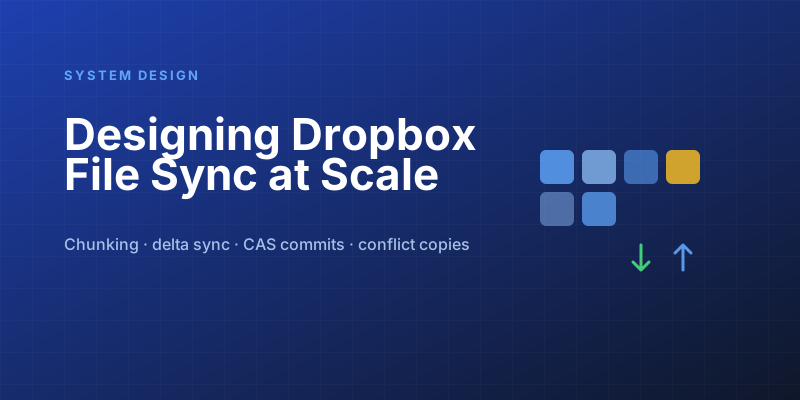
A user edits one paragraph in a 2GB PowerPoint on a hotel Wi-Fi connection, and three seconds later the change is on their laptop at home. Uploading 2GB obviously did not happen. The entire design of a file sync service falls out of one decision: files are not the unit of storage — chunks are.
Requirements
Functional: sync a folder across devices, share folders between users, version history, offline edits that reconcile later. Non-functional: handle files from 1KB to 50GB, minimize bandwidth (users on metered connections), sync latency of a few seconds, never lose a byte — durability beats availability here.
Split metadata from blocks
The first structural move: two planes with completely different access patterns.
- Block storage — immutable, content-addressed chunks in object storage (S3). Huge volume, dumb operations: put chunk, get chunk.
- Metadata service — the file tree: which files exist, which chunk list makes up each version, sharing ACLs, version history. Small data, strongly consistent, transactional (Dropbox runs this on sharded MySQL).
Clients talk to both: negotiate state with the metadata service, then move only missing chunks to/from block storage.
Chunking: why content-defined beats fixed-size
Naive: split every file into fixed 4MB chunks, hash each (SHA-256), store by hash. Content addressing gives you deduplication for free — a chunk shared by a thousand users is stored once — and integrity checking falls out of the name.
The subtle failure: insert one byte at the front of a file and every fixed-size chunk boundary shifts, so every hash changes, so you re-upload the whole file. The fix is content-defined chunking: slide a rolling hash (Rabin fingerprint) over the bytes and cut a chunk wherever the hash matches a pattern. Boundaries are determined by content, not offsets, so an insertion only changes the chunk it lands in and its immediate neighbors.
def chunks(data, mask=0xFFF):        # ~4KB average chunk
    start = 0
    h = RollingHash()
    for i, byte in enumerate(data):
        h.roll(byte)
        if h.value & mask == 0 or i - start >= MAX_CHUNK:
            yield sha256(data[start:i+1]), data[start:i+1]
            start = i + 1
    if start < len(data):
        yield sha256(data[start:]), data[start:]
Delta sync is then just set arithmetic: client computes chunk hashes, asks the metadata service "which of these do you not have," and uploads only those. The 2GB PowerPoint edit becomes a few hundred KB.
The sync protocol
A file version is a manifest: an ordered list of chunk hashes plus metadata. Committing an upload is a metadata transaction: "create version N+1 of file F with this chunk list, parent version N."
That parent version field is the concurrency control. It makes commits compare-and-swap: if two devices both commit against parent N, the first wins and the second gets a conflict — the server never silently overwrites.
1. Client watches FS events, chunks changed file, hashes
2. POST /commit {file_id, parent_version: N, chunks: [h1..hk]}
3. Server: missing chunks? -> 412 + list -> client uploads to block store -> retry
4. Server: parent stale?   -> 409 conflict
5. Success: version N+1; notify other devices (long-poll/WebSocket)
6. Other devices pull manifest, fetch missing chunks, rebuild file
Notification is a long-poll or WebSocket channel carrying only "namespace changed, cursor X" — devices then pull the delta since their cursor. Push the signal, pull the data: it keeps fan-out cheap and clients correct after sleep/offline gaps.
Conflicts: do not merge, fork
Two devices edit the same file offline. On reconnect, both commit against parent N; one gets a 409. For arbitrary binary files, automatic merging is impossible — and last-writer-wins destroys someone's work, which for a file product is unforgivable.
The right answer is the boring one Dropbox ships: keep both. The losing commit becomes report (Rishi's conflicted copy 2026-07-13).docx. Both versions preserved, human resolves. In the interview, saying "LWW" here is the fastest way to fail; data loss is the one non-negotiable.
Version history is nearly free: manifests are tiny, chunks are immutable and shared across versions. Old versions cost only the chunks that changed. Garbage collection — deleting chunks no manifest references — needs care: reference-count asynchronously, delete lazily, never inline with user actions.
Scale notes
Metadata shards by namespace (user or shared folder) so one folder's commits serialize on one shard — which is exactly the CAS semantics you want. Block traffic goes straight to object storage with pre-signed URLs so bytes never flow through your API tier. Cold chunks tier down to cheaper storage classes.
| Interview probe | Answer sketch |
|---|---|
| Rename a 10GB file? | Metadata-only op — chunk list unchanged, zero bytes move |
| Dedupe across users? | Content addressing; add per-user encryption keys and you lose it (privacy trade-off, say it explicitly) |
| Millions of tiny files? | Batch commits; pack small chunks; metadata QPS is the bottleneck, not bandwidth |
| Sync loop storm? | Cursor-based deltas + jittered backoff; idempotent commits by content hash |
The one-line summary: content-addressed chunks + CAS commits on a strongly consistent metadata service + conflict copies instead of merges.
Keep reading
Write Skew: The Anomaly Snapshot Isolation Does Not Catch
Two transactions each read what the other writes, both commit, and an invariant dies. Snapshot isolation allows write skew — here is how to close the hole.
Designing a Shopping Cart: Price Snapshots, Merge, and No Inventory Hold
A cart is a per-user document, not a reservation. What to store on the line, how to merge an anonymous cart at login, and when the price is allowed to change.
Designing Snowflake-Style IDs: Ordering, Workers, and Clock Rollback
A 64-bit id from a timestamp, a worker number, and a per-millisecond sequence. How many you can issue, why the clock must not step backwards, and why JavaScript cannot hold one.
PostgreSQL 19 on October 29: WAIT for Read-Your-Writes, REPACK Without the Lock, and What Got Pulled
PostgreSQL 19 GA is scheduled for October 29, 2026. The WAIT command gives standbys read-your-writes, REPACK CONCURRENTLY replaces VACUUM FULL and CLUSTER, autovacuum goes parallel, and SQL/PGQ, online checksums, and FOR PORTION OF were reverted in Beta 4.
Idempotency Keys for Write APIs
How to make POST safe to retry: the key, the stored response, the race between two identical requests, and the expiry that forgets too soon.
Read-Your-Writes: The User Just Saved and the Read Replica Does Not Know
Why a write to the primary followed by a read from a replica shows stale data, and the practical ways to pin the next read without sending all traffic to the primary.
Newsletter
New posts, straight to your inbox
One email per post. No spam, no tracking pixels, unsubscribe anytime.
Comments
- No comments yet. Be the first.