Designing an S3-Style Object Store: Erasure Coding and the Metadata Layer
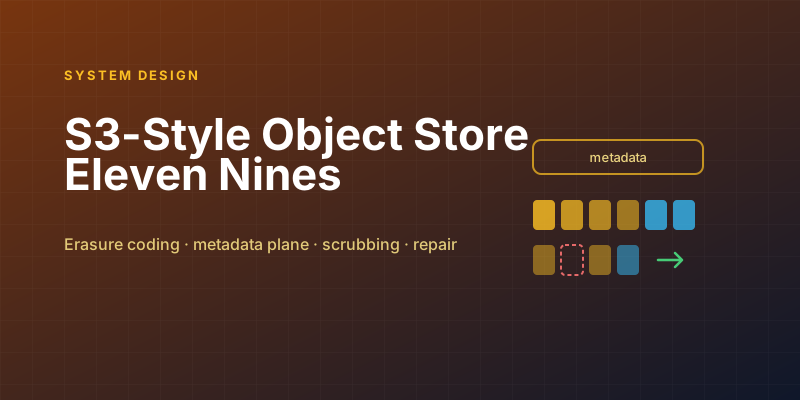
S3 promises eleven nines of durability — lose one object in ten million, on average, per ten thousand years. No single disk, machine, or even datacenter can make that promise; the design has to manufacture durability out of statistically unreliable parts. Designing an object store is really designing three loosely coupled systems — a metadata plane, a data plane, and a repair plane — and knowing why they must be separate.
Requirements and the API contract
PUT/GET/DELETE/LIST over objects (bytes + key + metadata) in buckets. Objects are immutable — you overwrite whole objects, never edit bytes in place — which is the simplification that makes everything else tractable. Durability 99.999999999%, availability ~4 nines, objects from 1KB to 5TB, strong read-after-write consistency (S3 has promised this since 2020).
Split the planes
Metadata plane: key → object version → list of chunk locations, plus buckets, ACLs, multipart state. Small records, strong consistency, high QPS. A sharded, replicated KV store (Raft groups per shard, or Spanner-style) — metadata is where consistency lives.
Data plane: dumb storage nodes holding immutable chunks. Operations: write chunk, read chunk, checksum chunk. No consensus in the hot path — the chunk placement decision was already recorded in metadata.
PUT /bucket/key
 1. API layer streams bytes, splits into chunks, checksums each
 2. picks placement (N nodes across failure domains), writes chunks
 3. commits metadata row {key, version, chunk_map} -- the atomic point
 4. ack client

GET = metadata lookup -> parallel chunk fetch -> verify checksums -> stream
The commit point is the metadata write. Chunks written but never committed are garbage (collected later); a committed row whose chunks are missing is a durability bug. Order of operations is the whole correctness argument: data first, then metadata, ack last. Read-after-write consistency falls out of the metadata store's consistency — this is why S3's move to strong consistency was a metadata-layer project, not a data-layer one.
Durability math: replication vs erasure coding
3x replication tolerates 2 failures at 3x storage cost. At exabyte scale, 3x is billions of dollars, so real object stores use erasure coding: split an object's data into k data fragments, compute m parity fragments (Reed-Solomon), store the k+m fragments on different machines/racks/AZs. Any k of the k+m fragments reconstruct the data.
| Scheme | Overhead | Tolerates | Read path |
|---|---|---|---|
| 3x replication | 3.0x | 2 losses | 1 node |
| RS(6+3) | 1.5x | 3 losses | 6 nodes |
| RS(12+4) | 1.33x | 4 losses | 12 nodes |
EC's fine print, which is where the interview signal is: reads touch k nodes (worse tail latency — a straggler among 12 hurts more than among 1); small objects fit poorly (fragment overhead dominates — so small objects are 3x-replicated or packed into larger blocks and EC'd together); and repair traffic is enormous — rebuilding one lost fragment reads k fragments' worth of data. A common hybrid: replicate on ingest (fast, simple), erasure-code in the background once the object cools.
Placement must respect failure domains: fragments spread across racks and availability zones so correlated failures (switch, power, flood) do not take out more than m fragments. Placement is a constraint solver run at write time; its output is just rows in metadata.
Repair: durability is a verb
Eleven nines does not come from writing fragments once. Disks fail at ~1-2% AFR and, worse, rot silently (latent sector errors, bit flips). Durability is maintained by an always-on background plane:
- Scrubbing: continuously read every chunk, verify checksums, flag corruption. Every byte gets re-verified on a cycle measured in weeks.
- Repair queue: node/disk death enqueues re-replication or fragment reconstruction; the fleet burns a sizable, budgeted fraction of its I/O on repair at all times.
- The durability model is a race: MTTR vs the probability of m+1 overlapping failures. Halving repair time buys more durability than adding a parity fragment — which is why repair bandwidth is a first-class capacity-planning line item, not best-effort.
The parts everyone forgets
LIST is a range scan over the key space (prefix/... ordering), which is why metadata wants an ordered store (or an ordered index beside a hash store) — and why hot sequential key prefixes (logs/2026-07-13-*) can hammer one metadata shard. S3's per-prefix throughput guidance is that shard boundary showing through.
Multipart upload is metadata choreography: initiate → upload parts independently (each its own chunk set) → complete assembles the part list into one object version atomically. It exists because a 5TB single-stream PUT over a flaky link must be resumable per-part.
DELETE is a tombstone in metadata; chunks die later via garbage collection reconciling "chunks on disk" vs "chunks referenced" — with versioning, lifecycle rules, and in-flight multiparts as edge cases. GC bugs are how object stores actually lose data; deleting too eagerly is the catastrophic direction, so GC runs conservative, delayed, and audited.
The summary shape: consistency lives in a small metadata plane; scale lives in a dumb immutable data plane; durability lives in a repair plane that never sleeps. If your design has those three boxes and the commit point in the right place, the rest is parameter tuning.
Keep reading

Write Skew: The Anomaly Snapshot Isolation Does Not Catch
Two transactions each read what the other writes, both commit, and an invariant dies. Snapshot isolation allows write skew — here is how to close the hole.

Designing a Shopping Cart: Price Snapshots, Merge, and No Inventory Hold
A cart is a per-user document, not a reservation. What to store on the line, how to merge an anonymous cart at login, and when the price is allowed to change.
Designing Snowflake-Style IDs: Ordering, Workers, and Clock Rollback
A 64-bit id from a timestamp, a worker number, and a per-millisecond sequence. How many you can issue, why the clock must not step backwards, and why JavaScript cannot hold one.

PostgreSQL 19 on October 29: WAIT for Read-Your-Writes, REPACK Without the Lock, and What Got Pulled
PostgreSQL 19 GA is scheduled for October 29, 2026. The WAIT command gives standbys read-your-writes, REPACK CONCURRENTLY replaces VACUUM FULL and CLUSTER, autovacuum goes parallel, and SQL/PGQ, online checksums, and FOR PORTION OF were reverted in Beta 4.

Idempotency Keys for Write APIs
How to make POST safe to retry: the key, the stored response, the race between two identical requests, and the expiry that forgets too soon.

Read-Your-Writes: The User Just Saved and the Read Replica Does Not Know
Why a write to the primary followed by a read from a replica shows stale data, and the practical ways to pin the next read without sending all traffic to the primary.
Newsletter
New posts, straight to your inbox
One email per post. No spam, no tracking pixels, unsubscribe anytime.
Comments
- No comments yet. Be the first.