Distributed ID Generation: Snowflake, ULID, and the Clock-Skew Problem
AUTO_INCREMENT is one of those features you only appreciate after you lose it. The moment you shard a database or accept writes in two regions, a single counter that hands out 1, 2, 3 stops existing — and it turns out an ID scheme has to satisfy more constraints than "unique": generation must not require coordination on the hot path, IDs should sort roughly by creation time (your indexes and your pagination care), they must fit in 64 bits if you want cheap joins, and they should not leak business intelligence. That last one is real: sequential order IDs let a competitor place one order per week and read your growth rate off the IDs — the classic German tank problem.
Why not just UUIDv4?
Random UUIDs are coordination-free and collision-proof, which is why they are everywhere. Two problems at scale:
Index locality. A B-tree clusters nearby keys on the same pages. Random 128-bit keys scatter every insert to a random page — every insert touches a cold page, the working set becomes the whole index, page splits multiply, and your buffer cache stops caching anything useful. On a table doing thousands of inserts per second, switching the primary key from UUIDv4 to a time-ordered ID is one of the highest-leverage index optimizations available.
Size. 128 bits versus 64 doubles the footprint of every foreign key and every secondary index entry that carries the primary key.
Snowflake: 64 bits, three fields
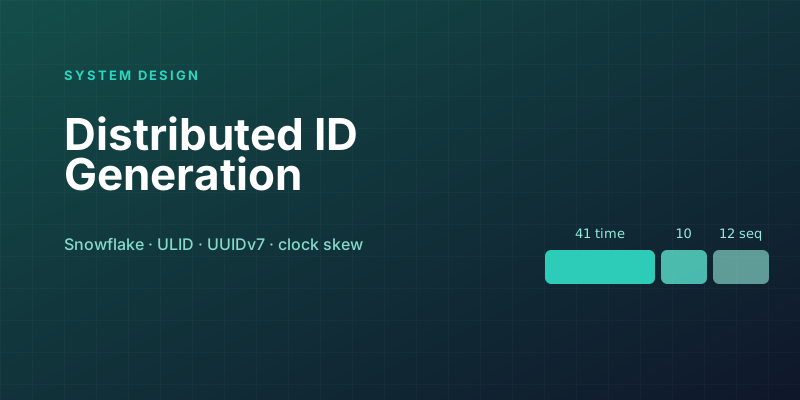
Twitter's Snowflake layout is the canonical answer, and every large company runs some variant of it:
 63          62........22  21........12  11...........0
+---+---------------------+-------------+---------------+
| 0 |  timestamp (41 bit) | worker (10) | sequence (12) |
+---+---------------------+-------------+---------------+
  41 bits of milliseconds since a custom epoch  → ~69 years
  10 bits of worker ID                          → 1,024 generators
  12 bits of per-millisecond sequence           → 4,096 IDs/ms/worker
Timestamp in the high bits makes IDs sort by creation time — new rows append to the right edge of the B-tree, range scans by time become primary-key scans, and cursor pagination gets a natural key. Each worker generates locally with zero coordination: read the clock, bump the sequence, done. Ceiling: about 4 million IDs per second per worker.
The two problems Snowflake creates:
Worker ID assignment. Two generators sharing a worker ID silently mint duplicates. You need each instance to hold a unique 0–1023 identity: leased from etcd/ZooKeeper at startup, derived from a StatefulSet ordinal, or assigned from instance metadata. This is the operational cost of the scheme — uniqueness now depends on ops discipline rather than math.
Clock skew. The generator trusts the machine clock, and NTP can step a clock backwards. A generator that already issued IDs for time T, then sees T minus 30ms, will re-issue colliding IDs. Standard defenses: track the last timestamp used and refuse to go backwards (wait out small regressions, alarm and halt on large ones), and run clock-sanity checks against peers. Sonyflake and others trade bit widths for more tolerance. If you remember one failure mode from this post, make it "NTP stepped the clock back and the ID generator kept going."
ULID and UUIDv7: the same idea, standardized
ULID (48-bit timestamp + 80 random bits, Crockford base32) and UUIDv7 — now standardized in RFC 9562 — apply the identical trick at 128 bits: time in the high bits for sort order and index locality, randomness in the low bits for coordination-free uniqueness with no worker registry at all.
| Scheme | Bits | Sorted? | Coordination | Notes |
|---|---|---|---|---|
| Auto-increment | 64 | Yes | Single node | Dies at sharding; leaks volume |
| UUIDv4 | 128 | No | None | Index locality pain |
| Snowflake | 64 | Yes | Worker registry | Clock skew is your problem |
| ULID / UUIDv7 | 128 | Yes | None | The easy default in 2026 |
| DB ticket server | 64 | Roughly | Central service | Flickr-style; SPOF to manage |
My default advice: UUIDv7 unless you have a reason — native support landed in Postgres 18, and it deletes the worker-ID problem entirely. Reach for Snowflake when 64-bit keys measurably matter (storage-heavy tables, join-heavy workloads) and you are prepared to operate worker identity properly. The ticket-server pattern (a MySQL instance whose only job is REPLACE INTO on an auto-increment, made HA with two servers issuing odd/even) is a legitimate low-tech middle ground.
Two fine-print items
Time-ordered IDs recreate hot partitions. If the ID is also your shard key under range partitioning, all new writes land in the newest range — the exact skew problem time-ordered keys cause everywhere. Hash the ID for placement, or shard on a different key.
Rough order, not order. Snowflake IDs order by generator clock, not by any global truth; two IDs minted 2ms apart on different workers can invert. Fine for feeds and pagination; not fine as a causality or concurrency-control mechanism. If "which write happened first" has correctness consequences, you need versions or consensus, not timestamps in IDs.
Takeaways
ID generation is a miniature distributed-systems problem: uniqueness without coordination, ordering without a global clock. Time-in-high-bits is the trick that makes IDs both unique and index-friendly, whether spelled Snowflake, ULID, or UUIDv7. Choose UUIDv7 by default, Snowflake when 64 bits pay rent, and in either case decide before the incident what happens when the clock goes backwards — because eventually it will.
Keep reading
Write Skew: The Anomaly Snapshot Isolation Does Not Catch
Two transactions each read what the other writes, both commit, and an invariant dies. Snapshot isolation allows write skew — here is how to close the hole.

Designing a Shopping Cart: Price Snapshots, Merge, and No Inventory Hold
A cart is a per-user document, not a reservation. What to store on the line, how to merge an anonymous cart at login, and when the price is allowed to change.
Designing Snowflake-Style IDs: Ordering, Workers, and Clock Rollback
A 64-bit id from a timestamp, a worker number, and a per-millisecond sequence. How many you can issue, why the clock must not step backwards, and why JavaScript cannot hold one.

PostgreSQL 19 on October 29: WAIT for Read-Your-Writes, REPACK Without the Lock, and What Got Pulled
PostgreSQL 19 GA is scheduled for October 29, 2026. The WAIT command gives standbys read-your-writes, REPACK CONCURRENTLY replaces VACUUM FULL and CLUSTER, autovacuum goes parallel, and SQL/PGQ, online checksums, and FOR PORTION OF were reverted in Beta 4.

Idempotency Keys for Write APIs
How to make POST safe to retry: the key, the stored response, the race between two identical requests, and the expiry that forgets too soon.

Read-Your-Writes: The User Just Saved and the Read Replica Does Not Know
Why a write to the primary followed by a read from a replica shows stale data, and the practical ways to pin the next read without sending all traffic to the primary.
Newsletter
New posts, straight to your inbox
One email per post. No spam, no tracking pixels, unsubscribe anytime.
Comments
- No comments yet. Be the first.