Designing a Dynamo-Style KV Store: Quorums, Hinted Handoff, and Vector Clocks
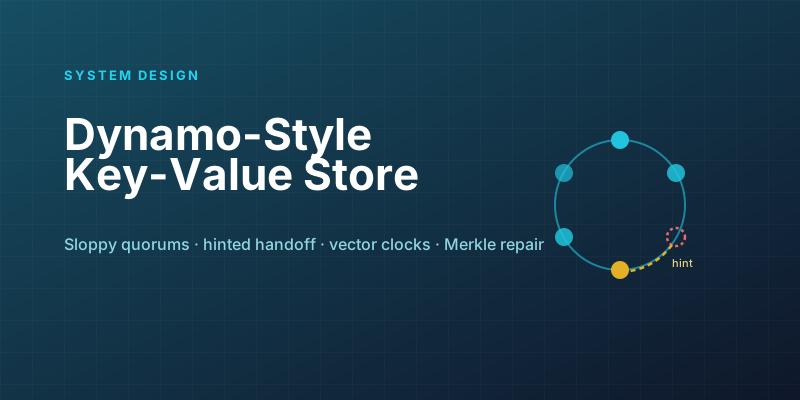
Amazon's Dynamo paper starts from a business constraint, not a technical one: the shopping cart must accept writes during any failure, because a rejected add-to-cart is lost revenue. Everything strange about Dynamo-style stores — sloppy quorums, vector clocks, conflicts handed back to the application — follows from refusing to ever say no to a write. If Spanner is what "choose consistency" looks like when fully engineered, Dynamo is the fully engineered version of choosing availability.
The skeleton
Keys placed on a consistent hash ring; each key replicated to N nodes (the next N distinct physical nodes clockwise — the "preference list"). Every node can accept any request and route it (or clients route directly with ring awareness). No leader, no failover event — the design's first big claim: no single point whose death needs detecting before writes continue.
Quorums: tuning knobs, not guarantees
Write to W replicas before acking; read from R. With N=3:
| Config | Behavior |
|---|---|
| W=3, R=1 | Slow writes, fast reads, no overlap during failures |
| W=1, R=1 | Fast everything, weakest guarantees |
| W=2, R=2 | R+W > N: read set and write set must intersect — reads see the latest acked write, usually |
"Usually," because Dynamo quorums are sloppy: if a preference-list node is unreachable, the write lands on the next healthy node around the ring instead, tagged with a hint ("this belongs to node A — deliver when it recovers"). That is hinted handoff: availability preserved, but now R+W>N is not a hard intersection guarantee — the read quorum may miss the hinted write entirely. Say this in an interview and you have separated yourself from everyone who memorized "R+W>N means strong consistency."
put(k, v):  coordinator -> N preference nodes
            node C down -> write to D with hint(C)
            ack after W responses
get(k):     read R replicas -> versions differ? -> resolve, read-repair
Versioning: what "conflict" means without a leader
Two clients write the same key through different coordinators during a partition. Neither write is "later" in any meaningful sense — wall clocks lie. Two schemes:
Last-write-wins (LWW): highest timestamp survives. Simple, and silently drops one write. Cassandra chose this default — fine for "latest sensor reading," quietly catastrophic for a shopping cart.
Vector clocks: each version carries {node: counter} per updating node. Comparing clocks tells you descends (one includes the other's history — keep the newer) or concurrent (neither does — keep both as siblings and return both on read; the application merges).
v1 {A:1}          v2 {A:1,B:1}      -> v2 descends v1: keep v2
v2 {A:1,B:1}      v3 {A:2}          -> concurrent: siblings, client merges
cart merge: union of items  (deletes need tombstones, or they resurrect)
The cart merge is the famous example precisely because union is a safe merge — and the equally famous fine print is deletion: without tombstones recording "removed at version X," a merge resurrects deleted items. Deletion in leaderless systems is always a recorded event, never an absence (the same lesson as Kafka compaction tombstones). Modern descendants push merging into the data types themselves — CRDTs are vector-clock-era conflict handling made systematic.
Repair: three layers, three time scales
Replicas drift — hinted writes, missed messages, node replacement. Convergence is manufactured:
- Read repair (milliseconds): read touches R replicas; any stale ones get updated with the winning/merged version inline. Hot keys self-heal.
- Hinted handoff replay (minutes): recovered nodes receive their held hints.
- Anti-entropy (hours, continuous): background pairwise sync of entire key ranges using Merkle trees — replicas exchange hash-tree roots and descend only into differing subtrees, so comparing a billion keys costs log-depth hash exchanges plus the actual diffs. Cold keys that nobody reads still converge.
That trio — inline, event-driven, and scheduled repair — is a reusable pattern worth naming for any eventually consistent design.
Membership and failure detection
No master decides who is alive. A gossip protocol spreads membership and liveness: each node periodically exchanges state with random peers; failures are suspected locally (missed heartbeats through gossip) and acted on locally (route around, write hints). Ring changes (join/leave) propagate the same way, shifting key ranges gradually. Coordination-free membership is what makes "any node can serve any request" true even while the cluster's view is briefly inconsistent — the design tolerates a fuzzy membership view because every layer above it already tolerates staleness.
Where this design wins and loses
Wins: write availability through partitions and node loss, predictable low latency (no cross-region consensus in the hot path), smooth incremental scaling, operational symmetry (every node identical). Loses: no transactions, no "read your own write" without careful quorum/session tricks, conflict handling exported to application code, tombstone and sibling management as a permanent operational tax.
Deployed descendants each moved one dial: Cassandra kept the ring but chose LWW + tunable consistency; Riak kept vector clocks/CRDTs; DynamoDB-the-product hid all of it behind a managed API with LWW semantics and added optional strong reads. The interview move is to state the dial explicitly: per-key linearizability needs a leader or consensus somewhere — if the requirement is "never refuse a write," this is the architecture, and conflict resolution is the bill, payable by the application.
Keep reading
Write Skew: The Anomaly Snapshot Isolation Does Not Catch
Two transactions each read what the other writes, both commit, and an invariant dies. Snapshot isolation allows write skew — here is how to close the hole.
Designing a Shopping Cart: Price Snapshots, Merge, and No Inventory Hold
A cart is a per-user document, not a reservation. What to store on the line, how to merge an anonymous cart at login, and when the price is allowed to change.
Designing Snowflake-Style IDs: Ordering, Workers, and Clock Rollback
A 64-bit id from a timestamp, a worker number, and a per-millisecond sequence. How many you can issue, why the clock must not step backwards, and why JavaScript cannot hold one.
PostgreSQL 19 on October 29: WAIT for Read-Your-Writes, REPACK Without the Lock, and What Got Pulled
PostgreSQL 19 GA is scheduled for October 29, 2026. The WAIT command gives standbys read-your-writes, REPACK CONCURRENTLY replaces VACUUM FULL and CLUSTER, autovacuum goes parallel, and SQL/PGQ, online checksums, and FOR PORTION OF were reverted in Beta 4.
Idempotency Keys for Write APIs
How to make POST safe to retry: the key, the stored response, the race between two identical requests, and the expiry that forgets too soon.
Read-Your-Writes: The User Just Saved and the Read Replica Does Not Know
Why a write to the primary followed by a read from a replica shows stale data, and the practical ways to pin the next read without sending all traffic to the primary.
Newsletter
New posts, straight to your inbox
One email per post. No spam, no tracking pixels, unsubscribe anytime.
Comments
- No comments yet. Be the first.