Multi-Tenant Data Isolation: Row-Level, Schema-Level, Database-Level, and How to Choose
Multi-tenancy is a decision you make once, early, and regret quietly for years if you picked wrong. The three patterns — row-level isolation, schema-level isolation, and database-level isolation — each have real-world SaaS companies that swear by them. They are swearing by them for different reasons.
This post is the decision framework I apply when a team is choosing, plus the concrete migration paths between them. No framework advocacy.
The Three Patterns
Row-level isolation. One database, one set of tables, a tenant_id column on every tenant-scoped row. All queries filter by tenant_id. This is what most SaaS starts as.
Schema-level isolation. One database, one schema per tenant. Tables are duplicated across schemas. Queries route to the tenant's schema. This pattern is less common on Postgres and more common in enterprise SQL Server shops.
Database-level isolation. One database per tenant (or one cluster per tenant for very large ones). Full physical separation. Routing happens at the connection level.
Each is isolating something different: row-level is logical isolation via predicates, schema-level is namespace isolation, database-level is physical isolation.
Row-Level: The Default
What you get:
- One codebase, one migration, one operational surface
- Cheap to run — per-tenant cost is essentially free
- Easy cross-tenant aggregates (admin dashboards, analytics)
- Simple backup and restore at the database level
What you pay:
- A single noisy tenant can consume enough resources to impact everyone
- A forgotten
tenant_idfilter in a query is a data leak - Per-tenant restore is hard — you cannot easily reset one tenant's data without affecting others
- Compliance conversations get harder ("prove tenant A's data is not commingled with tenant B's")
The forgotten-filter risk is real. The mitigation I use on Postgres is row-level security:
CREATE POLICY tenant_isolation ON invoices
  USING (tenant_id = current_setting('app.current_tenant')::uuid);

ALTER TABLE invoices ENABLE ROW LEVEL SECURITY;
And in the request middleware:
async def set_tenant_context(request):
    tenant_id = get_tenant_from_auth(request)
    await db.execute("SET LOCAL app.current_tenant = $1", tenant_id)
Now the predicate is enforced by the database, not by your application. Forgetting the filter becomes a zero-rows query, not a data leak. This is the single highest-leverage change you can make in a row-level system.
Schema-Level: The Middle Path
What you get:
- Stronger logical isolation — a schema boundary is enforced, not relied on
- Per-tenant restore is possible (restore one schema's tables)
- Backup per tenant is possible
- Same database server, so operational cost stays low
What you pay:
- Schema count grows with tenant count — at 10,000 schemas, tooling breaks down
- Migrations are more complex (apply to each schema, coordinate versioning)
- Cross-tenant queries are harder (still possible with multiple schema references)
- Postgres connection pooling gets weird — different search_path per tenant
Schema-level works cleanly up to roughly the low thousands of tenants, beyond which the metadata overhead (Postgres catalog tables grow, query planning slows) becomes visible. If you are a B2B SaaS with dozens to hundreds of large enterprise tenants, this is a good fit. If you have 50,000 small-business tenants, this pattern will hurt.
Database-Level: The Strong Isolation Option
What you get:
- Full physical isolation — the strongest story for compliance
- Tenant-specific performance tuning, indexes, versions
- Per-tenant backup, restore, failover, and recovery are natural
- Blast radius of a bad query is one tenant
What you pay:
- Significantly higher infrastructure cost
- Operationally expensive — more databases to monitor, patch, upgrade
- Cross-tenant reporting becomes a data-warehouse problem, not a database query
- Onboarding a new tenant is a provisioning step, not an insert statement
This pattern shines for enterprise SaaS with serious compliance requirements — HIPAA, SOC 2 Type II with strict customer isolation requirements, regulated industries. It also shines for multi-region deployments where tenant A's data must stay in the EU and tenant B's in the US.
The cost story is real. A database-per-tenant architecture with 100 tenants is 100 databases you are paying for, maintaining, backing up, and monitoring. You need automation (Terraform or equivalent) for provisioning, or the operational load crushes the team.
A Hybrid Pattern: Pooled + Isolated
The pattern I recommend for most new SaaS companies is hybrid:
- Free / self-serve tier → row-level isolation, shared database
- Business / team tier → row-level isolation, possibly with per-tenant partitioning
- Enterprise tier → database-level isolation, optionally in the customer's preferred region
This matches the cost structure. Low-margin small tenants get the cheapest infrastructure; high-margin enterprise customers get the isolation they want to pay for. Your engineering team ships once (row-level) and adds the database-level provisioning when the first enterprise customer requires it.
The key is keeping your application code tenant-aware regardless of pattern. Every query and every write includes tenant_id. Every connection is scoped to a tenant at request start. This way, "split this large tenant to its own database" is a routing change, not a codebase rewrite.
Migration Paths
Moving from row-level to schema-level is uncommon in practice. Moving from row-level to database-level for specific tenants is very common. Here is the shape:
- Provision a new database for the target tenant (automated from day one).
- Replicate live data. For Postgres, logical replication with a publication filtered to that tenant's rows. Read replicas, slowly, until caught up.
- Dual-write window. Application writes to both source and target. Reads still come from source.
- Switch reads. Tenant requests now route to the new database. Keep dual-write for a safety window.
- Stop writes to source, verify, delete source data.
This is boring, well-understood work. The main gotchas:
- Sequence values must be preserved on the migrated database. Otherwise you get primary key collisions if you ever re-merge data.
- Foreign key references to shared data (reference tables, lookup tables) must be replicated or handled.
- Background jobs that were reading from the shared database need to be tenant-aware and route correctly.
Allow a week per large tenant the first time you do this. Once the tooling is in place, subsequent migrations can be hours.
The Data Leak You Will Eventually Have
Every row-level system has had this incident: a query is missing the tenant filter, and tenant A sees tenant B's data for the two hours before anyone notices. I have seen it happen three times in my career, once on my own code.
The patterns that prevent it:
- RLS on the database side. As shown above. The best single defense.
- Tenant-scoped ORMs. A data access layer that injects
tenant_idinto every query. Developers do not write the filter; the layer does. - Schema-level or database-level isolation for sensitive data. For anything under strong regulatory requirements, do not trust the application layer to get it right.
- Audit queries. A nightly job that scans query logs for queries against tenant-scoped tables without a
tenant_idpredicate. False positives exist, but the catch rate is high.
Every one of these is better than "we train developers to remember the filter." Training does not scale.
Compliance and Blast Radius
Three questions a compliance officer will ask, and the answer depends on your isolation pattern:
"Can tenant A's data be included in tenant B's backup?" Row-level: yes, all backups are global. Schema-level: you can restore one schema. Database-level: no, each tenant has its own backups.
"If tenant A issues a legal hold or a GDPR delete, how fast can you isolate or remove their data?" Row-level: minutes, with a well-scoped delete. Schema-level: faster — drop or restrict the schema. Database-level: trivial — pause or delete the database.
"What is the blast radius of a bug in your application?" Row-level: up to "all tenants affected." Schema-level: usually one tenant, but cross-tenant bugs exist. Database-level: one tenant.
The right answer depends on what you are building. A collaboration tool for small teams probably does not need database-level isolation. A healthcare records platform probably does. Knowing why you picked what you picked is the point.
A Default Recommendation
For a new B2B SaaS with no compliance requirements beyond standard SOC 2:
- Start row-level with RLS enforced at the database
- Add per-tenant partitioning for tables that grow with usage (>100M rows)
- Build the database-per-tenant provisioning tooling before you need it — when an enterprise customer asks, you have an answer
- Use the hybrid pattern once you have a customer tier that justifies it
For a new SaaS in a regulated industry:
- Start database-per-tenant even though it feels like over-engineering
- Automate provisioning from day one — manual onboarding will not scale
- Invest in cross-tenant observability (a data warehouse, usage rollups) because you will need it and it is harder to retrofit
Neither is the "right" answer in isolation. The right answer is the one that matches what you are selling and to whom.
One Practical Constraint
Whatever you pick, commit to the patterns in your code: every tenant-scoped table has a tenant column, every query is tenant-scoped, every connection carries tenant context. The worst multi-tenant system is not the wrong pattern — it is a codebase that cannot tell you, for any given piece of data, which tenant owns it.
Get that right on day one. The rest becomes a provisioning decision, and provisioning decisions are much easier to change than codebase decisions.
Keep reading
Designing Chat Presence: Online, Away, and the Lie of Instant Status
Heartbeat vs subscriptions, fan-out of presence, privacy, and why a boolean online flag does not survive a million concurrent sockets.
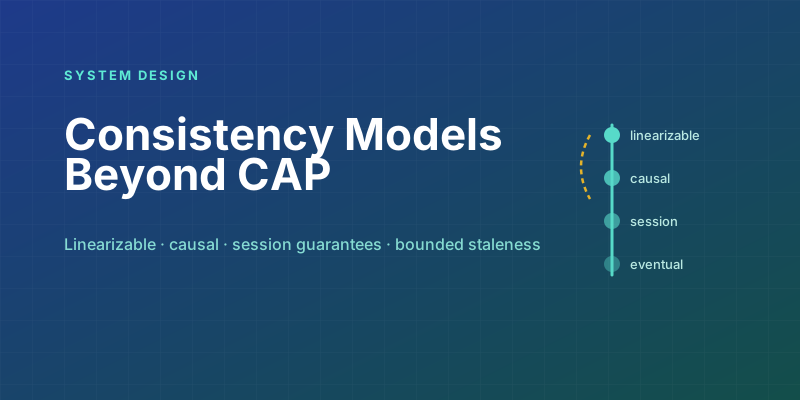
Consistency Models Beyond CAP: Linearizability, Causal, and Session Guarantees
'Strong vs eventual' is a cartoon. The real spectrum — linearizable, sequential, causal, session guarantees — and how to pick per operation, not per system.
Designing an API Gateway: The Front Door as a System
Authentication, routing, rate limits, transformations, and a plugin chain — in a tier that must add ~1ms and never be the outage. Envoy/Kong architecture from scratch.
Designing a CDC Pipeline: Change Data Capture from Binlog to Downstream
Dual writes are a lie; the database's own log is the truth. Log-based CDC, the snapshot-plus-stream handoff, schema evolution, and ordering guarantees that survive resharding.
Designing a Content Moderation Pipeline: Trust and Safety at Platform Scale
A billion uploads a day, a legal requirement to act in hours, and irreversible mistakes in both directions: hash matching, classifier tiers, human review queues, and appeals.
Designing a Distributed Rate Limiter: Local Buckets, Global Truth
One user, twenty gateway nodes, one limit of 100 req/s. Where does the counter live? Redis+Lua atomicity, the local-cache compromise, and failing open vs closed.
Newsletter
New posts, straight to your inbox
One email per post. No spam, no tracking pixels, unsubscribe anytime.
Comments
- No comments yet. Be the first.