Circuit Breakers: Stopping a Cascading Failure Before It Spreads
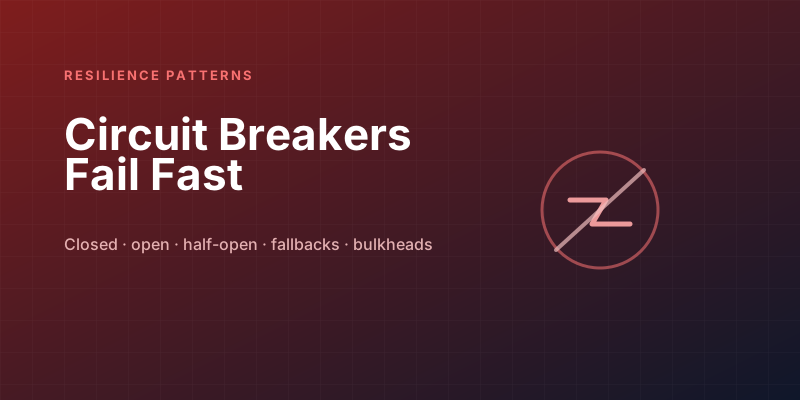
A recommendation service starts responding in 8 seconds instead of 80 milliseconds. It is not down — just slow, maybe a bad deploy or a struggling database. Your product-page service calls it on every request. Each request now holds a thread for 8 seconds waiting. Your thread pool fills. New requests queue, then time out. The product page, which only decorates itself with recommendations, is now fully down. Meanwhile the checkout service that shares a load balancer with the product page starts getting starved too. One slow, non-critical dependency just took out your storefront.
The circuit breaker exists to break this chain. It is named after the electrical kind for a reason: when current surges, the breaker trips and cuts the circuit so the house doesn't burn down. You flip it back on once things are safe.
The failure it prevents
The danger isn't the dependency being slow. The danger is your service waiting on it. Every thread parked on a slow call is a thread not serving other traffic. Retries make it worse — three retries against a struggling service triple its load at the exact moment it can least handle it, and you've built a self-reinforcing death spiral. This is how a localized problem becomes a cascading failure that crosses service boundaries.
A circuit breaker changes the default. Instead of "call the dependency and hope," it tracks the dependency's recent health and, when health is bad, fails immediately without making the call at all. Fast failure frees your threads, sheds load off the sick dependency, and lets you serve a degraded-but-alive experience.
Three states
The breaker is a small state machine wrapped around a remote call.
- Closed — normal operation. Calls pass through. The breaker counts failures.
- Open — tripped. Calls fail instantly (or return a fallback) without touching the dependency. After a cooldown, it moves to half-open.
- Half-open — probationary. A limited number of trial calls are allowed through. If they succeed, the breaker closes and traffic resumes. If they fail, it snaps back open and the cooldown restarts.
        failures exceed threshold
 CLOSED ─────────────────────────────▶ OPEN
   ▲                                     │
   │ trial calls succeed       cooldown elapses
   │                                     ▼
   └──────────────  HALF-OPEN  ◀─────────┘
         (one bad trial → back to OPEN)
The half-open state is the part people skip, and skipping it is a mistake. Without it you either stay open forever (and never recover) or slam the full load back onto a dependency that may still be sick. Half-open is a single careful knock on the door before you let everyone back in.
A minimal implementation
import time

class CircuitBreaker:
    def __init__(self, fail_threshold=5, cooldown=30, trial_calls=1):
        self.fail_threshold = fail_threshold
        self.cooldown = cooldown
        self.trial_calls = trial_calls
        self.state = "closed"
        self.failures = 0
        self.opened_at = 0.0
        self.trials = 0

    def call(self, fn, *args, fallback=None):
        if self.state == "open":
            if time.monotonic() - self.opened_at >= self.cooldown:
                self.state = "half_open"
                self.trials = 0
            else:
                return self._reject(fallback)

        try:
            result = fn(*args)
        except Exception:
            self._on_failure()
            if fallback is not None:
                return fallback
            raise
        else:
            self._on_success()
            return result

    def _on_success(self):
        if self.state == "half_open":
            self.trials += 1
            if self.trials >= self.trial_calls:
                self.state = "closed"
                self.failures = 0
        else:
            self.failures = 0

    def _on_failure(self):
        self.failures += 1
        if self.state == "half_open" or self.failures >= self.fail_threshold:
            self.state = "open"
            self.opened_at = time.monotonic()

    def _reject(self, fallback):
        if fallback is not None:
            return fallback
        raise RuntimeError("circuit open")
Production libraries — Resilience4j on the JVM, Polly in .NET, the breakers built into most service meshes — add rolling time windows, percentage-based thresholds, and metrics. But this is the whole idea. A breaker is not complicated; getting the thresholds right is the hard part.
Tuning is where people get it wrong
The defaults above are illustrative, not gospel. Bad thresholds make the breaker either useless or itself an outage:
- Too sensitive and the breaker trips on a normal traffic blip, cutting off a healthy dependency and causing the outage it was meant to prevent.
- Too lax and it never trips when it should, so you get no protection.
Prefer a percentage over a rolling window ("trip if more than 50% of the last 20 calls failed") to a raw count, because a flat count behaves wildly differently at 10 requests/second versus 10,000. And count slow calls as failures, not just errors — a dependency returning 200 OK in 9 seconds is doing more damage than one returning a clean 503 in 5 milliseconds. The whole point is to protect your threads; a slow success still parks a thread.
Fallbacks: what to do while the breaker is open
Failing fast is only half the value. The other half is what you return instead. Good fallbacks degrade gracefully:
- Serve a cached or slightly stale version of the data.
- Return a sensible default (an empty recommendations list, not an error page).
- Drop the optional feature entirely and render the rest of the page.
The principle: a non-critical dependency should never be able to fail a critical path. If recommendations are down, the product page still loads — just without recommendations. Decide the fallback deliberately at design time, because the worst time to discover you have no fallback is when the breaker has just tripped in production.
Where it fits — and where it doesn't
Circuit breakers belong on every cross-service and cross-network boundary: calls to other microservices, third-party APIs, and anything else that can be slow or unavailable independently of you. Pair them with timeouts (so a call can't hang forever in the first place) and bulkheads (isolated thread pools per dependency, so one saturated pool can't starve the others). The three together — timeout, bulkhead, breaker — are the standard kit for resilient service-to-service calls.
They do not help with in-process logic, a slow local computation, or a fundamentally overloaded system where every dependency is the problem. A breaker contains a localized failure; it cannot conjure capacity you do not have. But for the overwhelmingly common case — one dependency goes bad and threatens to take everything down with it — the circuit breaker is the difference between a degraded feature and a front-page outage.
Keep reading

Write Skew: The Anomaly Snapshot Isolation Does Not Catch
Two transactions each read what the other writes, both commit, and an invariant dies. Snapshot isolation allows write skew — here is how to close the hole.

Designing a Shopping Cart: Price Snapshots, Merge, and No Inventory Hold
A cart is a per-user document, not a reservation. What to store on the line, how to merge an anonymous cart at login, and when the price is allowed to change.
Designing Snowflake-Style IDs: Ordering, Workers, and Clock Rollback
A 64-bit id from a timestamp, a worker number, and a per-millisecond sequence. How many you can issue, why the clock must not step backwards, and why JavaScript cannot hold one.
PostgreSQL 19 on October 29: WAIT for Read-Your-Writes, REPACK Without the Lock, and What Got Pulled
PostgreSQL 19 GA is scheduled for October 29, 2026. The WAIT command gives standbys read-your-writes, REPACK CONCURRENTLY replaces VACUUM FULL and CLUSTER, autovacuum goes parallel, and SQL/PGQ, online checksums, and FOR PORTION OF were reverted in Beta 4.
Idempotency Keys for Write APIs
How to make POST safe to retry: the key, the stored response, the race between two identical requests, and the expiry that forgets too soon.

Read-Your-Writes: The User Just Saved and the Read Replica Does Not Know
Why a write to the primary followed by a read from a replica shows stale data, and the practical ways to pin the next read without sending all traffic to the primary.
Newsletter
New posts, straight to your inbox
One email per post. No spam, no tracking pixels, unsubscribe anytime.
Comments
- No comments yet. Be the first.