Consistent Hashing: How Distributed Systems Avoid the Great Reshuffle
You run a cache cluster of four nodes. A key lands on a node via hash(key) % 4. It works beautifully until the day you add a fifth node and switch to % 5. Now almost every key maps to a different node than before. Your cache hit rate collapses to near zero, every miss hammers the database, and the database falls over. You added capacity and caused an outage.
This is the problem consistent hashing solves. The idea is small, the implementation is a hundred lines, and the failure modes are subtle enough that people who "know" consistent hashing still get bitten. Let me walk through it properly.
Why modulo hashing betrays you
hash(key) % N distributes keys evenly across N nodes, which is the part everyone notices. The part that hurts is what happens when N changes. Changing the divisor changes the result for nearly every key, because the modulo of a large number is extremely sensitive to the divisor.
Concretely, moving from 4 to 5 nodes remaps roughly 80% of keys. The fraction that stays put is only about 1/max(old, new). For a cache, a remap means a miss. For a sharded database, a remap means data is now on the wrong shard and must be physically moved. Either way, a routine scaling event becomes a thundering-herd incident.
The goal we actually want: when the node count changes by one, only about 1/N of keys should move. That is what consistent hashing delivers.
The ring
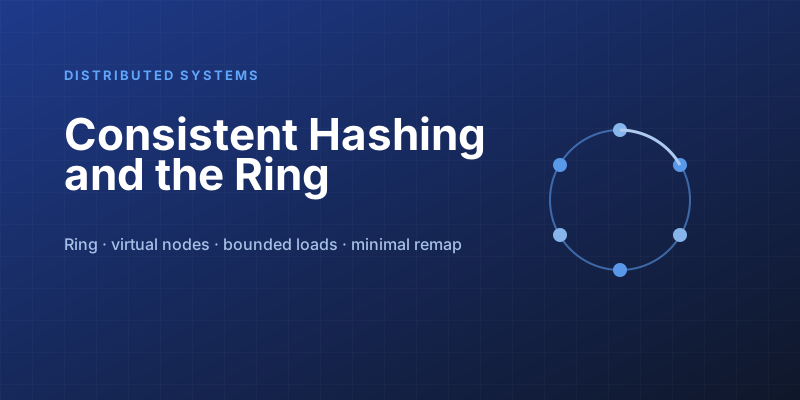
Picture a circle of hash values, say 0 to 2^32 - 1, wrapping around at the top. You place both nodes and keys on this ring using the same hash function.
- Each node is hashed (e.g.,
hash("cache-node-3")) to a point on the ring. - Each key is hashed to a point on the ring.
- A key is owned by the first node found walking clockwise from the key's position.
        node A (hash 10)
          •
   key→ •     • node B (hash 90)
        |
  node D •         • key
  (270)   \       /
           • node C (180)
Now add a node. It lands at one point on the ring and takes over only the arc between itself and the previous node. Every other key keeps its owner. Removing a node hands its arc to the next node clockwise, and again nothing else moves. That is the whole trick: a node is responsible for a contiguous arc, and adding or removing a node disturbs exactly one arc.
The catch: uneven distribution
A pure ring with one point per node has a problem. With only a handful of nodes hashed to random positions, the arcs are wildly uneven — one node might own 40% of the ring and another 5%. Hashing is uniform in expectation, but with five samples the variance is brutal. You bought balanced scaling and got lopsided load.
The fix is virtual nodes (sometimes called vnodes or replicas). Instead of placing each physical node once, you place it many times — say 150 points per node, each derived from hash("cache-node-3#0"), hash("cache-node-3#1"), and so on.
import hashlib
import bisect

class HashRing:
    def __init__(self, nodes=None, vnodes=150):
        self.vnodes = vnodes
        self.ring = {}            # hash -> node
        self.sorted_keys = []     # sorted hash positions
        for node in nodes or []:
            self.add(node)

    def _hash(self, key: str) -> int:
        return int(hashlib.md5(key.encode()).hexdigest(), 16)

    def add(self, node: str):
        for i in range(self.vnodes):
            h = self._hash(f"{node}#{i}")
            self.ring[h] = node
            bisect.insort(self.sorted_keys, h)

    def remove(self, node: str):
        for i in range(self.vnodes):
            h = self._hash(f"{node}#{i}")
            del self.ring[h]
            self.sorted_keys.remove(h)

    def get(self, key: str) -> str:
        if not self.ring:
            return None
        h = self._hash(key)
        idx = bisect.bisect(self.sorted_keys, h) % len(self.sorted_keys)
        return self.ring[self.sorted_keys[idx]]
With 150 vnodes per physical node, the standard deviation of load drops dramatically — each node ends up owning many small arcs scattered around the ring, and the law of large numbers smooths the distribution. The lookup is a binary search over the sorted positions, so it stays O(log V) where V is the total number of vnodes.
The number of vnodes is a real tuning knob. Too few and load is uneven; too many and your ring data structure bloats and add/remove get slow. Somewhere between 100 and 200 per node is a sane default for most systems; very large clusters sometimes go lower per node because the node count itself provides averaging.
Bounded loads: when "mostly even" is not even enough
Virtual nodes give you statistical balance, but a hot key or a slightly unlucky placement can still overload one node. If a single popular key maps to one node, vnodes do not help — that key has one home.
Google's consistent hashing with bounded loads addresses the overload case: define a capacity c = (1 + ε) · average_load, and when a key's natural owner is at capacity, walk clockwise to the next node with spare room. This caps any node at (1 + ε) times the mean while still moving only a small number of keys when the cluster changes. It is worth knowing about the day someone shows you a load graph with one node pinned at 100% and the rest idle.
For genuinely hot individual keys, the answer is upstream of the ring: replicate the hot key to multiple nodes, or add a small local cache in front. No partitioning scheme fixes a key that is simply too popular for one machine.
Where the ring quietly breaks
A few things bite teams in production:
- Different hash functions on different clients. Every client that routes to the ring must use the exact same hash function and the exact same vnode-naming scheme. One service using MD5 and another using a 32-bit truncation will route the same key to different nodes, and you will chase a phantom consistency bug for a week.
- Non-deterministic node identity. If node names include a restart timestamp or an ephemeral pod IP, every restart reshuffles the ring. Use stable identities.
- Replication and the ring. Storing
Nreplicas of a key usually means taking the nextNdistinct physical nodes clockwise — note distinct physical, not the nextNvnodes, which might all belong to the same machine. Forgetting the "distinct physical" rule silently kills your redundancy. - Membership disagreement. During a deploy, some clients see the old ring and some see the new one. For a cache this is a brief, self-healing miss storm. For a datastore it can mean reads and writes routing to different nodes — you need a membership protocol (gossip, a coordinator, or a config service) so the ring converges quickly.
When you actually need it
Consistent hashing earns its keep when you have a stateful, partitioned system where node membership changes and remapping is expensive: distributed caches (Memcached clients, the original use case), sharded datastores (DynamoDB, Cassandra, Riak all use a ring or a close cousin), and load balancers that want session affinity without sticky cookies.
If your data lives behind a single database and the cache is small enough to lose entirely on a deploy, you do not need this — % N and a cold cache might be fine. The moment a remap means moving terabytes or melting your origin, reach for the ring. It is one of those algorithms that looks like a curiosity until the day it is the only thing standing between you and a very long night.
Keep reading

Write Skew: The Anomaly Snapshot Isolation Does Not Catch
Two transactions each read what the other writes, both commit, and an invariant dies. Snapshot isolation allows write skew — here is how to close the hole.

Designing a Shopping Cart: Price Snapshots, Merge, and No Inventory Hold
A cart is a per-user document, not a reservation. What to store on the line, how to merge an anonymous cart at login, and when the price is allowed to change.

Designing Snowflake-Style IDs: Ordering, Workers, and Clock Rollback
A 64-bit id from a timestamp, a worker number, and a per-millisecond sequence. How many you can issue, why the clock must not step backwards, and why JavaScript cannot hold one.

PostgreSQL 19 on October 29: WAIT for Read-Your-Writes, REPACK Without the Lock, and What Got Pulled
PostgreSQL 19 GA is scheduled for October 29, 2026. The WAIT command gives standbys read-your-writes, REPACK CONCURRENTLY replaces VACUUM FULL and CLUSTER, autovacuum goes parallel, and SQL/PGQ, online checksums, and FOR PORTION OF were reverted in Beta 4.

Idempotency Keys for Write APIs
How to make POST safe to retry: the key, the stored response, the race between two identical requests, and the expiry that forgets too soon.

Read-Your-Writes: The User Just Saved and the Read Replica Does Not Know
Why a write to the primary followed by a read from a replica shows stale data, and the practical ways to pin the next read without sending all traffic to the primary.
Newsletter
New posts, straight to your inbox
One email per post. No spam, no tracking pixels, unsubscribe anytime.
Comments
- No comments yet. Be the first.