Designing a CDC Pipeline: Change Data Capture from Binlog to Downstream
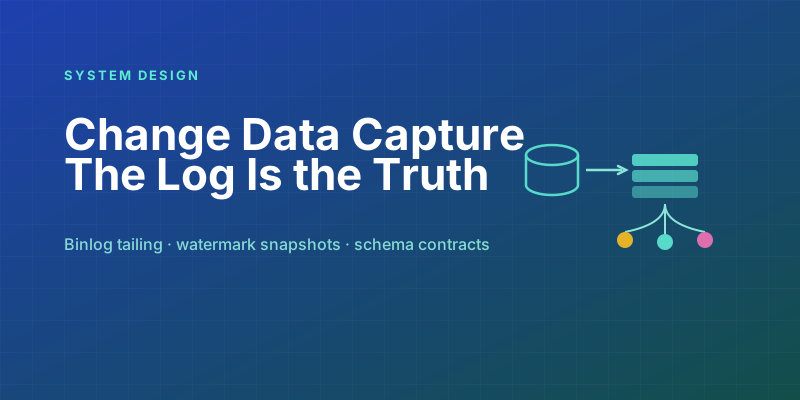
Every data team eventually needs the same thing: the OLTP database's changes, delivered elsewhere — to the search index, the cache, the warehouse, the fraud model. The obvious approach, dual writes ("write to Postgres and publish to Kafka"), is a correctness trap: the two writes aren't atomic, so crashes and races leave the copies permanently diverged, and no retry policy fixes a fork. Change data capture inverts the approach: stop announcing your changes — let the pipeline read the database's own write-ahead log, the one place where the truth is already totally ordered and durable.
The capture layer: tailing the log
Every serious database exposes its replication stream: MySQL binlog, Postgres logical decoding (WAL → row events via a replication slot), MongoDB change streams. A CDC connector (Debezium being the reference design) poses as a replica, decodes row-level events — INSERT/UPDATE/DELETE with before/after images — and publishes them, typically one Kafka topic per table, partitioned by primary key so each row's history stays ordered:
{op: "u", before: {id: 42, status: "pending"},
          after:  {id: 42, status: "paid"},
 source: {lsn: 0x1A2B3C, table: "orders"}, ts_ms: ...}
Two properties fall out for free, and they're the whole reason to do it this way: nothing is missed (the log is the database's own definition of what happened — triggers, bulk updates, and out-of-band scripts included, which application-level events never reliably capture), and order per key is the commit order. The connector tracks its position (LSN/GTID) as a consumer offset; crash → resume from the last recorded position → at-least-once delivery of an idempotent-by-nature stream (row events carry full state, so downstream upserts absorb replays).
The hard part everyone skips: the initial snapshot
A new consumer needs the current table contents plus all changes after — and the table is being written while you copy it. The naive "dump, then stream" loses or duplicates the writes that happened mid-dump unless the handoff is exact. The clean design (DBLog/Debezium's watermark approach): interleave chunked snapshot reads with the live stream, using watermarks to deduplicate — mark position, read chunk, mark again; any streamed event for a key inside the chunk window supersedes the snapshot row. Result: a consistent snapshot without locking the source, resumable per chunk. In an interview, distinguishing "bootstrap" from "tail" — and knowing the bootstrap is the hard 20% — is what separates people who've operated CDC from people who've read about it.
Schema evolution: the operational 80%
ALTER TABLE happens; the pipeline must not corrupt or halt. DDL flows through the same log; the connector maintains an internal schema history and stamps every event with its schema version, while a schema registry enforces compatibility rules downstream (backward-compatible changes — add nullable column — flow through; breaking changes — drop/retype a column — get stopped at the source and force a coordinated migration: new topic, dual-publish window, consumer cutover). The registry is the data-contract enforcement point: without it, one hasty ALTER at 2am becomes silent nulls in the warehouse and a fraud model scoring garbage. Unglamorous, decisive.
Delivery semantics and the transformation tier
Downstream consumers see at-least-once, per-key-ordered events. The standard consumption patterns, each one sentence: cache invalidation — evict/upsert on event (TTL as backstop); search indexing — upsert documents, with a version check (event.lsn > doc.lsn) making replays harmless; warehouse — append raw events, then merge into current-state tables on a schedule (dbt-style), keeping the append log as the audit trail; event-carried state transfer — other services materialize local replicas of the table they keep asking you for. For consumers wanting transactions rather than rows, the log also carries transaction boundaries — buffering a transaction's events until its commit marker restores atomicity that per-row topics lose (and is exactly what feeding a read model demands).
Two sharp edges to name before the interviewer does. Resharding the source: key-partitioned topics preserve per-key order only while the partition count is fixed — plan topic partitioning up front or accept an ordering epoch on split. The outbox alternative: when what you want downstream is a domain event ("OrderPlaced") rather than row diffs, CDC on an outbox table gives you both worlds — the app writes the event in the same transaction as the data, CDC ships it exactly-once-ish; that's the transactional outbox pattern with CDC as its delivery mechanism, and choosing between "row CDC" and "outbox CDC" is a modeling decision, not a technology one.
| Interview probe | Answer sketch |
|---|---|
| Why not triggers writing to a queue table? | Triggers tax every write, are per-table toil, and the queue table becomes its own contention point; log tailing is invisible to the workload |
| Replication slot fills the disk? | The classic Postgres incident: a stalled consumer pins WAL forever — monitor slot lag, alert, and have a drop-and-resnapshot playbook |
| Exactly-once into the warehouse? | At-least-once + idempotent merge (dedupe on LSN/PK) — same answer as every exactly-once question, and it's fine |
| Multi-region source failover? | GTID-based positions survive primary failover; without them, CDC must re-anchor — say "position portability" and you've said the risk |
The durable principle: the write-ahead log is the database's own event stream — capture it instead of duplicating it. Dual writes ask two systems to agree; CDC asks one system to remember, and it already does.
Keep reading
Write Skew: The Anomaly Snapshot Isolation Does Not Catch
Two transactions each read what the other writes, both commit, and an invariant dies. Snapshot isolation allows write skew — here is how to close the hole.
Designing a Shopping Cart: Price Snapshots, Merge, and No Inventory Hold
A cart is a per-user document, not a reservation. What to store on the line, how to merge an anonymous cart at login, and when the price is allowed to change.
Designing Snowflake-Style IDs: Ordering, Workers, and Clock Rollback
A 64-bit id from a timestamp, a worker number, and a per-millisecond sequence. How many you can issue, why the clock must not step backwards, and why JavaScript cannot hold one.
PostgreSQL 19 on October 29: WAIT for Read-Your-Writes, REPACK Without the Lock, and What Got Pulled
PostgreSQL 19 GA is scheduled for October 29, 2026. The WAIT command gives standbys read-your-writes, REPACK CONCURRENTLY replaces VACUUM FULL and CLUSTER, autovacuum goes parallel, and SQL/PGQ, online checksums, and FOR PORTION OF were reverted in Beta 4.
Idempotency Keys for Write APIs
How to make POST safe to retry: the key, the stored response, the race between two identical requests, and the expiry that forgets too soon.
Read-Your-Writes: The User Just Saved and the Read Replica Does Not Know
Why a write to the primary followed by a read from a replica shows stale data, and the practical ways to pin the next read without sending all traffic to the primary.
Newsletter
New posts, straight to your inbox
One email per post. No spam, no tracking pixels, unsubscribe anytime.
Comments
- No comments yet. Be the first.