Designing a Content Moderation Pipeline: Trust and Safety at Platform Scale
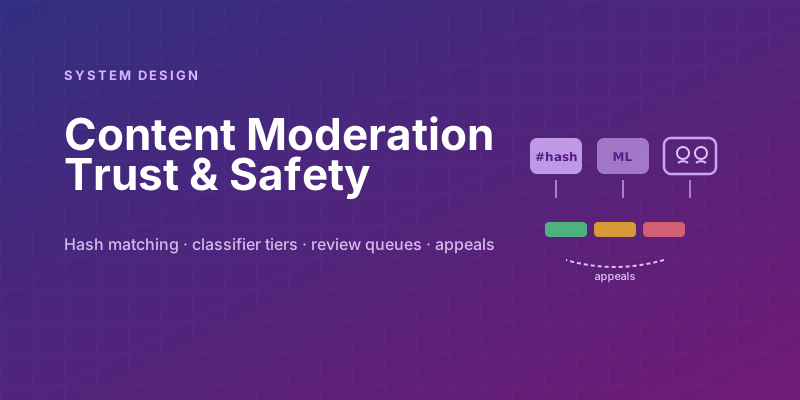
Content moderation is the system design question with asymmetric catastrophic errors in both directions: leave abusive content up and real people are harmed (plus regulators arrive with deadlines measured in hours); take legitimate content down and you've silenced someone wrongly at scale. Add a billion daily uploads, adversaries who actively probe your defenses, and human reviewers who are both the scarcest resource and the ones absorbing psychological harm — and you get a pipeline design where the routing of uncertainty is the whole game.
The tiered pipeline
No single mechanism survives the volume, so moderation is a funnel ordered by cost and confidence — the recommender funnel's dark twin:
upload -> HASH MATCHING (known-bad, ~exact)      -> block at ingest
       -> CLASSIFIERS (ML per harm type)          -> high conf: auto-action
                                                  -> uncertain: enqueue
       -> HUMAN REVIEW (queues, tiered expertise) -> decision + label
       -> APPEALS (second human, audit trail)     -> reversal signal
Tier 1 — hash matching catches known abusive material at ingest: cryptographic hashes for exact copies, perceptual hashes (PhotoDNA-class, resistant to resizing/re-encoding) for near-duplicates, shared industry hash sets for the worst categories (CSAM via NCMEC, terror content via GIFCT). This tier is cheap, precise, runs synchronously in the upload path, and is legally non-optional in several categories. Design notes: perceptual-hash matching is a nearest-neighbor problem in Hamming space (the SimHash machinery again), and the hash lists themselves are sensitive — distributed to edge matchers as encrypted blooms/indexes, never as raw material.
Tier 2 — classifiers, one per harm family (nudity, violence, hate, spam, self-harm), because harms have different signals, thresholds, and legal regimes. Each outputs a score feeding a three-way decision: auto-remove above a high-precision threshold, ignore below a low one, and — the design's center — route the uncertain middle to humans. Text models run inline; image/video models run near-line (seconds); expensive video understanding runs async with provisional availability. Virality changes the calculus: content accelerating toward 100K views earns re-scoring and priority review because its blast radius grew — the queue is risk-ordered, not FIFO.
Human review: the scarce, expensive, harmed resource
The review system is a work-distribution problem with constraints no other queue has. Prioritization by expected harm (severity × predicted reach × classifier uncertainty), not arrival time. Routing by specialization: language, market/legal context, harm type — a self-harm case needs a trained reviewer with wellness protocols, not a generalist. Quality control: golden tasks (known-answer items seeded into queues), double-review with adjudication for high-stakes categories, per-reviewer precision tracking. Reviewer welfare as an architectural requirement: exposure caps per shift for graphic categories, blurred/grayscale-first presentation with opt-in reveal, wellness rotations — these shape queue design as much as any throughput target, and mentioning them unprompted is the difference between having read about T&S and having thought about it.
Every human decision is a label: it feeds classifier retraining (the flywheel — human judgment converts to future machine coverage), threshold calibration, and — via appeals reversals — measurement of the false-positive rate that pure automation can't see about itself.
Appeals and the policy engine
Appeals are not a courtesy; they're the system's error-correction channel and increasingly a legal mandate (DSA-class regulation requires notice, reasons, and review). A second, independent reviewer sees the case with context (the policy clause cited, the classifier score, the first decision); reversals flow back as high-value training signals and as audit metrics per policy area. Everything is audit-logged immutably — who/what/why for every action — because regulators, courts, and transparency reports all consume it (and because "why was this removed" must be answerable years later).
The policy engine deserves explicit design: policies change weekly, so enforcement logic lives as versioned, declarative rules (policy X, clause Y, threshold Z per market) evaluated against classifier outputs and metadata — never hard-coded in the pipeline. Jurisdiction is a first-class dimension: the same content can be legal in one market and not another; actions are geo-scoped (blocked in market A, visible elsewhere), which means the enforcement state model is per-content × per-market, not a boolean.
Adversarial pressure closes the loop: evasion is constant (re-encoding to break hashes, leetspeak against text models, coordinated cross-account posting), so the system needs its own abuse telemetry — clusters of near-identical content from linked accounts (the fraud post's entity graph, repurposed), probing patterns against thresholds, and rapid-response hash listing when a novel harmful item starts spreading (crisis mode: minutes matter, virality curves don't wait for retraining).
| Interview probe | Answer sketch |
|---|---|
| Why not block everything the classifier flags? | Precision at scale: 99% precision on a billion items = 10M wrongful actions/day — the uncertain band must route to humans |
| Live streams? | Hardest mode: sampled frames + audio classifiers + viewer reports feeding a priority interrupt queue; latency budget is seconds and mistakes are public |
| Reviewer disagreement? | Adjudication layer + policy clarification loop — disagreement clusters are policy bugs, routed to policy owners, not just re-rolled |
| Metrics? | Prevalence (what slipped through, measured by sampling), action rate, appeal reversal rate, time-to-action at percentiles — and never celebrate volume of removals alone |
The distilled architecture: exact-match the known, classify the knowable, route uncertainty to prioritized humans, let appeals audit the machine, and version policy like code. The pipeline's real product isn't removals — it's defensible decisions at scale, each one reconstructable years later.
Keep reading
Write Skew: The Anomaly Snapshot Isolation Does Not Catch
Two transactions each read what the other writes, both commit, and an invariant dies. Snapshot isolation allows write skew — here is how to close the hole.

Designing a Shopping Cart: Price Snapshots, Merge, and No Inventory Hold
A cart is a per-user document, not a reservation. What to store on the line, how to merge an anonymous cart at login, and when the price is allowed to change.

Designing Snowflake-Style IDs: Ordering, Workers, and Clock Rollback
A 64-bit id from a timestamp, a worker number, and a per-millisecond sequence. How many you can issue, why the clock must not step backwards, and why JavaScript cannot hold one.
PostgreSQL 19 on October 29: WAIT for Read-Your-Writes, REPACK Without the Lock, and What Got Pulled
PostgreSQL 19 GA is scheduled for October 29, 2026. The WAIT command gives standbys read-your-writes, REPACK CONCURRENTLY replaces VACUUM FULL and CLUSTER, autovacuum goes parallel, and SQL/PGQ, online checksums, and FOR PORTION OF were reverted in Beta 4.
Idempotency Keys for Write APIs
How to make POST safe to retry: the key, the stored response, the race between two identical requests, and the expiry that forgets too soon.

Read-Your-Writes: The User Just Saved and the Read Replica Does Not Know
Why a write to the primary followed by a read from a replica shows stale data, and the practical ways to pin the next read without sending all traffic to the primary.
Newsletter
New posts, straight to your inbox
One email per post. No spam, no tracking pixels, unsubscribe anytime.
Comments
- No comments yet. Be the first.