Designing a Distributed Rate Limiter: Local Buckets, Global Truth
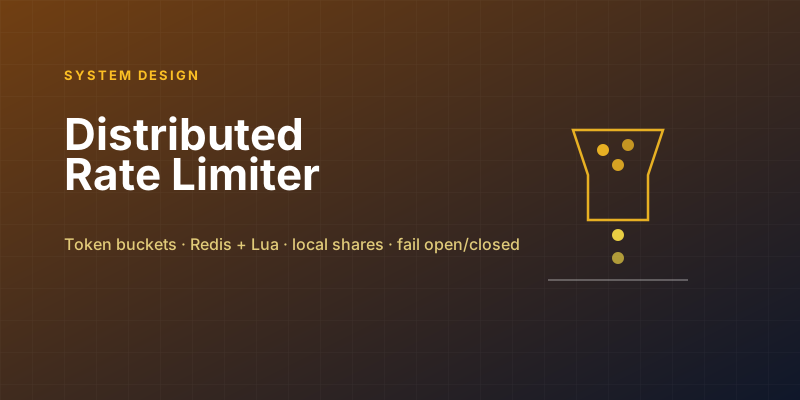
Rate limiting as an algorithm is a solved flashcard: token bucket, sliding window, done. Rate limiting as a system starts with an unpleasant question the flashcard hides: your API tier is fifty stateless gateway nodes behind a load balancer, the limit is "100 requests/second per API key," and a key's requests spray across all fifty nodes. Where does the counter live? Every answer is wrong in a different way, and the design skill is choosing your wrongness deliberately.
Requirements
Enforce per-key/per-user/per-endpoint limits across a horizontally scaled gateway fleet; decision latency ~1ms (it sits in front of everything); limits from 1/s to 100K/s; graceful behavior when the limiter itself degrades; useful rejection responses (429 + Retry-After).
The centralized answer: Redis, atomically
The baseline that works: counters in Redis (sharded by key), checked per request. The classic bug at this layer is the read-modify-write race — GET, decide, INCR as separate commands lets two concurrent requests both pass on the last token. The fix is making the decision atomic inside Redis with a Lua script (or Redis functions):
-- token bucket, atomic: KEYS[1]=bucket, ARGV = {rate, burst, now}
local tokens = tonumber(redis.call('HGET', KEYS[1], 't') or ARGV[2])
local last   = tonumber(redis.call('HGET', KEYS[1], 'ts') or ARGV[3])
tokens = math.min(ARGV[2], tokens + (ARGV[3] - last) * ARGV[1])
if tokens < 1 then return 0 end
redis.call('HSET', KEYS[1], 't', tokens - 1, 'ts', ARGV[3])
redis.call('PEXPIRE', KEYS[1], 60000)
return 1
Token bucket over fixed windows for the standard reason — fixed windows admit 2× bursts at boundaries; the bucket's burst parameter makes the burst policy explicit instead of accidental. TTLs keep the keyspace from accumulating one hash per key-that-ever-existed.
This design is correct and has two costs: a network round-trip on every request (~0.5-1ms, in front of everything), and Redis as a critical-path dependency with a hot-shard problem (one enormous customer = one hot key — familiar medicine applies).
The distributed answer: lie a little, locally
The insight that unlocks the better design: rate limits are not invariants, they are pressure valves. Nobody's data corrupts if a key gets 104 requests in a second against a limit of 100. Once you say that out loud, you can buy latency with bounded error:
each gateway node: local token bucket per key, budget = share of global limit
async sync loop (every 50-200ms): report usage to central store,
                                  rebalance shares by observed demand
Requests hit only node-local memory — nanoseconds, no network. The error is bounded by the sync interval: a key can exceed its limit by at most (burst headroom × nodes) between syncs. Demand-weighted rebalancing handles the skew case (all of a key's traffic landing on three of fifty nodes): nodes that see demand get bigger shares, idle nodes shrink toward zero, converging within a few sync rounds.
The honest framing for the interview: the centralized design is exactly correct and pays latency per request; the local design is approximately correct and pays with a tolerance band. Tier it — cheap local pre-filter in front (kills the flagrant abuse at zero cost), authoritative shared bucket behind it for keys near their limit — and you get both properties where each matters. Cloudflare and every large gateway run some version of this two-tier shape.
Failure policy is a product decision
The limiter will degrade — Redis partition, sync loop stalling. Two choices, both defensible, never accidental:
- Fail open: limiter unreachable → allow. Availability of the API preserved; abuse window opens. Right default for revenue-serving APIs with other abuse backstops.
- Fail closed: deny (or clamp to conservative local limits). Right for expensive/destructive operations — password attempts, SMS sends, LLM inference.
The refined version: fail open with local fallback buckets at conservative rates — degraded mode is "each node enforces a pessimistic share alone," so a Redis outage costs precision, not protection. Also: rejection is API surface — 429 with Retry-After and rate-limit headers (X-RateLimit-Remaining/Reset) turns well-behaved clients into cooperating backoff participants; silence turns them into synchronized retry storms (pair with jitter guidance in your SDKs).
Placement and layering
Real deployments run limits at multiple radii, and each layer catches what the previous can't:
| Layer | Granularity | Catches |
|---|---|---|
| CDN/edge | IP, coarse | Volumetric floods before they cost you compute |
| Gateway | API key, endpoint | Quota enforcement, tenant fairness (this post's system) |
| Service-local | per-instance concurrency | Overload protection regardless of who's asking — the load-shedding cousin |
The gateway tier is also where quota semantics live (monthly plans, spike allowances) — same buckets, longer windows, durable counters (a monthly quota can't live in volatile memory; it's a small ledger, and idempotent increment matters because gateway retries shouldn't double-charge a request).
| Interview probe | Answer sketch |
|---|---|
| Exactly 100, never 101? | Then it's not a rate limit, it's a semaphore — centralized atomic path only, pay the latency |
| Clock skew across nodes? | Buckets use each node's monotonic clock for refill; shares sync by interval, not timestamps — skew shifts error bands, doesn't break correctness |
| One key = 80% of traffic? | Hot-key handling: dedicated shard or fully-local shares for that key; detect via top-K sketch |
| Why not sticky-route each key to one node? | It works until one key exceeds one node's capacity — and you've rebuilt the hot-partition problem in your load balancer |
The transferable lesson: classify every "limit" by whether it protects an invariant (inventory, money — must be exact, centralize it) or applies pressure (rate limits, fairness — bounded error is fine, localize it). Systems that get this backwards are either slow everywhere or wrong where it counts.
Keep reading

Write Skew: The Anomaly Snapshot Isolation Does Not Catch
Two transactions each read what the other writes, both commit, and an invariant dies. Snapshot isolation allows write skew — here is how to close the hole.

Designing a Shopping Cart: Price Snapshots, Merge, and No Inventory Hold
A cart is a per-user document, not a reservation. What to store on the line, how to merge an anonymous cart at login, and when the price is allowed to change.
Designing Snowflake-Style IDs: Ordering, Workers, and Clock Rollback
A 64-bit id from a timestamp, a worker number, and a per-millisecond sequence. How many you can issue, why the clock must not step backwards, and why JavaScript cannot hold one.
PostgreSQL 19 on October 29: WAIT for Read-Your-Writes, REPACK Without the Lock, and What Got Pulled
PostgreSQL 19 GA is scheduled for October 29, 2026. The WAIT command gives standbys read-your-writes, REPACK CONCURRENTLY replaces VACUUM FULL and CLUSTER, autovacuum goes parallel, and SQL/PGQ, online checksums, and FOR PORTION OF were reverted in Beta 4.
Idempotency Keys for Write APIs
How to make POST safe to retry: the key, the stored response, the race between two identical requests, and the expiry that forgets too soon.

Read-Your-Writes: The User Just Saved and the Read Replica Does Not Know
Why a write to the primary followed by a read from a replica shows stale data, and the practical ways to pin the next read without sending all traffic to the primary.
Newsletter
New posts, straight to your inbox
One email per post. No spam, no tracking pixels, unsubscribe anytime.
Comments
- No comments yet. Be the first.