Designing Facebook TAO: A Read-Optimized Store for the Social Graph
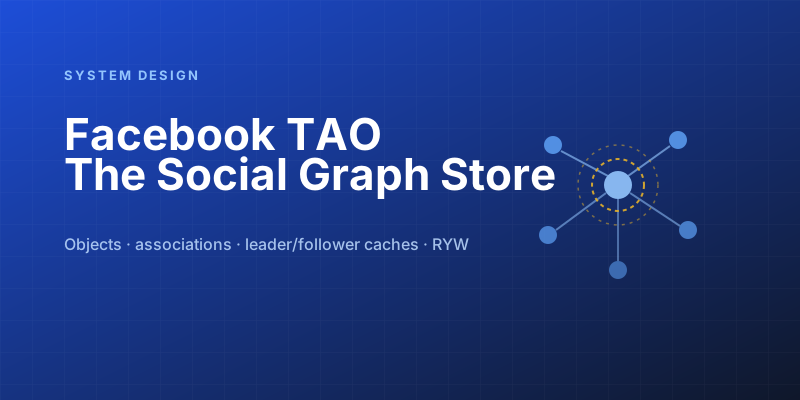
When engineers hear "social graph," they reach for a graph database. Facebook — owner of the largest social graph in existence — famously does not use one. TAO, the system serving that graph, is MySQL shards under two tiers of graph-aware cache, exposing an API so restricted it forbids most things graph databases are proud of. The restraint is the design: TAO is a masterclass in cutting features to fit a workload, and it's become a staple question for exactly that reason.
The workload dictates everything
The read:write ratio is extreme — roughly 1,000:1. Every page render fans into hundreds of tiny graph reads (this user's friends, this post's likes, is A tagged in B), latency budget in single-digit milliseconds, from data centers worldwide. Writes (a like, a comment) trickle by comparison but must be visible to their author immediately. Queries are shallow: point reads and one-hop association lists — nobody renders a page with a six-hop traversal. That last observation is the license for everything TAO refuses to do.
The data model: objects and associations
Two types, total:
object:      (id) -> {otype, key->value data}          # user, post, comment, page
association: (id1, atype, id2) -> {time, data}         # LIKES, FRIEND, AUTHORED
association lists: (id1, atype) -> [assocs, newest-first]
The API is deliberately tiny: get/create/update objects; add/delete associations; assoc_get(id1, atype, id2set), assoc_range(id1, atype, offset, limit) — time-ordered, paginated — and assoc_count(id1, atype). Inverse edges (FRIENDED_BY, LIKED_BY) are maintained as paired writes. No traversal language, no multi-hop queries, no transactions across objects. Friends-of-friends is composed by the application as two rounds of assoc_range — the system's restraint pushes the fan-out where it can be cached, batched, and load-shed per product decision.
The count query deserves its own note: assoc_count exists as a first-class, separately-cached primitive because "4.2M likes" must not cost reading 4.2M rows — precomputed counters maintained on write, the same denormalize-the-aggregate move every feed system makes.
Storage and the two cache tiers
Under the API: MySQL, sharded by object id (shard id embedded in the 64-bit id at creation); an association's row lives on id1's shard, so a node and its outgoing edge lists co-locate. InnoDB provides per-shard durability and ordered scans for assoc_range; the graph semantics live entirely above.
The cache is where the architecture is. Followers and leaders: many follower tiers (per web region/cluster) absorb the billion reads; on miss they consult the leader tier (one per database region), which alone talks to MySQL. Caches are graph-semantic, not byte-blobs — they understand association lists, so assoc_range(user, FRIEND, 0, 50) hits a structured list the cache maintains incrementally on writes rather than invalidating wholesale.
Writes flow up: follower → leader → MySQL, synchronously through the master region for that shard; the leader then feeds updates/invalidations back to its followers (asynchronously). Remote regions hold read replicas + their own leader/follower stacks; a remote write forwards to the master region and — the crucial touch — the originating follower applies the change locally at once. That is how TAO delivers its consistency contract: read-your-writes for the author, eventual (sub-second, typically) for everyone else. Your like appears instantly to you; your friend in Frankfurt may see it 400ms later. For a social graph that asymmetry is not a compromise — it is the requirements, stated precisely (session guarantee for the writer, causal-ish freshness for others).
The hot spot story
Celebrity posts are the adversarial case: millions of reads/sec against one object and one association list. TAO's layers each absorb some: hot objects replicate across many follower tiers (each caching it independently — read amplification becomes the friend it never is at the storage layer); leaders coalesce concurrent misses for the same key into one DB read (request coalescing, again); counters absorb the "how many likes" traffic that would otherwise be a scan. The write side of a viral post — everyone liking it — contends on one counter row, handled by batching increments at the leader. Same hot-key playbook as a distributed cache, executed at graph granularity.
| Interview probe | Answer sketch |
|---|---|
| Why not Neo4j/a graph DB? | Traversal engines optimize the queries this workload never issues, and give up the cache-tiering and shard-locality that the actual workload (1-hop reads at 10⁹/sec) demands |
| Consistency during region failover? | Master-region writes + async replication = a failover can lose recent writes' visibility ordering; TAO accepts brief anomalies — likes are not ledgers |
| New edge type with different fanout (follows vs friends)? | Association lists are time-ordered and paginated by design; asymmetric follow graphs work unchanged — celebrity lists are what the hot-spot machinery is for |
| Would you build TAO today? | Same shape, different parts: the pattern — restricted graph API, semantic caching, per-writer session guarantees over global consistency — outlives the MySQL specifics |
The transferable lesson is the method, not the system: start from the query distribution, delete every capability it doesn't need, and spend the freed complexity budget on the two things it does need — cache tiers shaped like the data, and exactly the consistency each reader requires, no more.
Keep reading
Write Skew: The Anomaly Snapshot Isolation Does Not Catch
Two transactions each read what the other writes, both commit, and an invariant dies. Snapshot isolation allows write skew — here is how to close the hole.

Designing a Shopping Cart: Price Snapshots, Merge, and No Inventory Hold
A cart is a per-user document, not a reservation. What to store on the line, how to merge an anonymous cart at login, and when the price is allowed to change.
Designing Snowflake-Style IDs: Ordering, Workers, and Clock Rollback
A 64-bit id from a timestamp, a worker number, and a per-millisecond sequence. How many you can issue, why the clock must not step backwards, and why JavaScript cannot hold one.
PostgreSQL 19 on October 29: WAIT for Read-Your-Writes, REPACK Without the Lock, and What Got Pulled
PostgreSQL 19 GA is scheduled for October 29, 2026. The WAIT command gives standbys read-your-writes, REPACK CONCURRENTLY replaces VACUUM FULL and CLUSTER, autovacuum goes parallel, and SQL/PGQ, online checksums, and FOR PORTION OF were reverted in Beta 4.
Idempotency Keys for Write APIs
How to make POST safe to retry: the key, the stored response, the race between two identical requests, and the expiry that forgets too soon.
Read-Your-Writes: The User Just Saved and the Read Replica Does Not Know
Why a write to the primary followed by a read from a replica shows stale data, and the practical ways to pin the next read without sending all traffic to the primary.
Newsletter
New posts, straight to your inbox
One email per post. No spam, no tracking pixels, unsubscribe anytime.
Comments
- No comments yet. Be the first.