Designing Typeahead Autocomplete: Sharded Tries and Precomputed Top-K
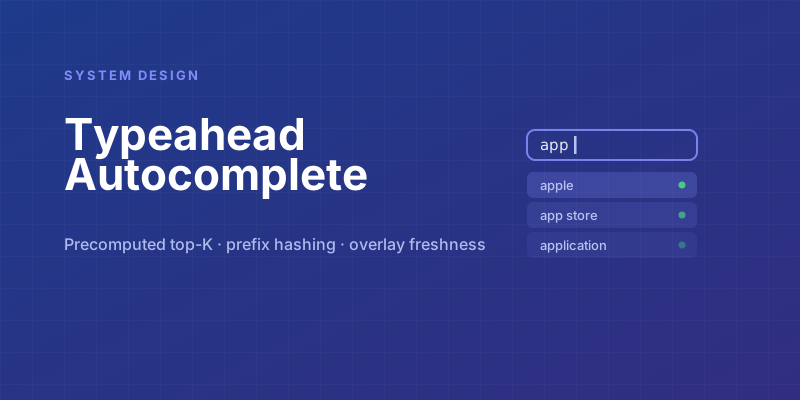
Autocomplete has the most hostile latency budget in consumer software. A user typing at 200ms per character fires a query per keystroke, and suggestions that arrive after the next keystroke are garbage — the effective deadline is ~100ms end-to-end, network included. That budget outlaws almost everything: no database query, no scoring pass over candidates, no fan-out to ten services. The design lesson autocomplete teaches better than any other system: when the read deadline is brutal, move all the work to write time.
Requirements
Suggest top 5-10 completions per prefix from a corpus of billions of historical queries; p99 under ~50ms server-side; suggestions reflect popularity and recency (a breaking-news term should surface within minutes-hours); personalize lightly; filter unsafe content.
The read path: a lookup, not a computation
The core structure is a trie over query strings — but the naive version (walk to the prefix node, DFS the subtree, collect completions, rank by frequency) does unbounded work per keystroke: prefix "a" has a subtree with hundreds of millions of descendants. DFS-at-read-time is the answer that fails the interview.
The fix: store the answer in the node. Each trie node holds its precomputed top-K completions.
node "app" -> ["apple", "apple watch", "app store", "application", ...]  (K=10)
read path: hash/walk to node -> return stored list -> done. O(prefix length).
Space math holds up: top-10 per node, with completions stored once and referenced by ID, keeps the whole structure memory-resident even at billions of queries — and memory-resident is non-negotiable at this deadline. Serving nodes hold the trie in RAM, replicated for throughput; a request touches exactly one shard (see below), so p99 is a single in-memory lookup plus network.
Two practical refinements interviewers reward: prefix hashing beats pointer-chasing (store prefix → top-K in a flat hash map; the "trie" is conceptual — cache-friendly, trivially serializable, and shardable by key), and client-side caching of results per prefix, since typing "appl" then backspacing to "app" should not re-query.
Sharding: not A-Z
The instinctive shard-by-first-letter is a skew disaster — 'a' and 's' carry orders of magnitude more traffic than 'x'. Shard by hash of the full prefix instead: hash("app") mod N. Every prefix lives on exactly one shard, load spreads uniformly, and a query still touches one shard (the client asks for the prefix it has, not a range). The trade: prefixes of one word scatter across shards, so there is no subtree locality — which costs nothing, because we never walk subtrees at read time. The precompute decision and the sharding decision reinforce each other; noticing that coupling is senior-level signal.
The write path: where the actual system lives
Suggestions come from query logs, so the pipeline is a streaming aggregation feeding periodic index builds:
search logs -> stream aggregation (count per query, sliding windows)
            -> candidate scoring: frequency × recency decay × quality/safety filters
            -> offline build: for every prefix of every candidate, compute top-K
            -> ship immutable index shards to servers (atomic pointer swap)
The top-K-per-prefix build is a classic MapReduce/Spark job: emit (prefix, query, score) for each prefix of each query (a 20-char query emits 20 pairs), group by prefix, keep K. Rebuild cadence — daily or hourly — is fine for the stable head of the distribution but fails breaking news, so real systems run a two-tier index: the big offline-built base, plus a small real-time overlay fed by the stream (last few hours' trending deltas), merged at read time. Two sorted lists of ~10 merged in-process is nanoseconds; freshness without touching the base build. Same lambda shape as ad-click counting — batch for truth, stream for now.
Scoring inside the build is where product lives: raw frequency plus time decay (score = Σ count_i × e^(-λ·age_i)), geography/language partitioning (separate indexes per locale beats per-query filtering), and the safety filter as a build-time exclusion list — filtering at read time means one config bug serves the unfiltered list.
Personalization stays out of the hot structure: fetch the user's recent-queries list (small, cached) and merge-boost client- or edge-side. Blending a per-user model into the shared index is how you turn one lookup into a scoring pass and blow the budget.
| Interview probe | Answer sketch |
|---|---|
| Why not Elasticsearch prefix queries? | Search engines score at read time; the deadline demands O(1) lookup of precomputed answers |
| Update top-K on every search, online? | Write amplification: one query touches 20 prefix entries under contention; stream + periodic merge wins |
| Multi-word / mid-word matching? | Index suffixes/word-boundaries too (bigger build, same read path) — state the space trade |
| Typos? | Fuzzy matching breaks the precompute; practical answer: small edit-distance expansion at the edge for short prefixes only |
The transferable principle, worth closing an interview with: precompute-at-write vs compute-at-read is a dial, and autocomplete sits at the extreme end — every design choice (per-node top-K, hash sharding, immutable index ships, overlay merges) is that one dial turned all the way.
Keep reading
Write Skew: The Anomaly Snapshot Isolation Does Not Catch
Two transactions each read what the other writes, both commit, and an invariant dies. Snapshot isolation allows write skew — here is how to close the hole.

Designing a Shopping Cart: Price Snapshots, Merge, and No Inventory Hold
A cart is a per-user document, not a reservation. What to store on the line, how to merge an anonymous cart at login, and when the price is allowed to change.
Designing Snowflake-Style IDs: Ordering, Workers, and Clock Rollback
A 64-bit id from a timestamp, a worker number, and a per-millisecond sequence. How many you can issue, why the clock must not step backwards, and why JavaScript cannot hold one.
PostgreSQL 19 on October 29: WAIT for Read-Your-Writes, REPACK Without the Lock, and What Got Pulled
PostgreSQL 19 GA is scheduled for October 29, 2026. The WAIT command gives standbys read-your-writes, REPACK CONCURRENTLY replaces VACUUM FULL and CLUSTER, autovacuum goes parallel, and SQL/PGQ, online checksums, and FOR PORTION OF were reverted in Beta 4.
Idempotency Keys for Write APIs
How to make POST safe to retry: the key, the stored response, the race between two identical requests, and the expiry that forgets too soon.
Read-Your-Writes: The User Just Saved and the Read Replica Does Not Know
Why a write to the primary followed by a read from a replica shows stale data, and the practical ways to pin the next read without sending all traffic to the primary.
Newsletter
New posts, straight to your inbox
One email per post. No spam, no tracking pixels, unsubscribe anytime.
Comments
- No comments yet. Be the first.