Designing a Web Crawler: The Frontier, Politeness, and Dedup at Billions of Pages
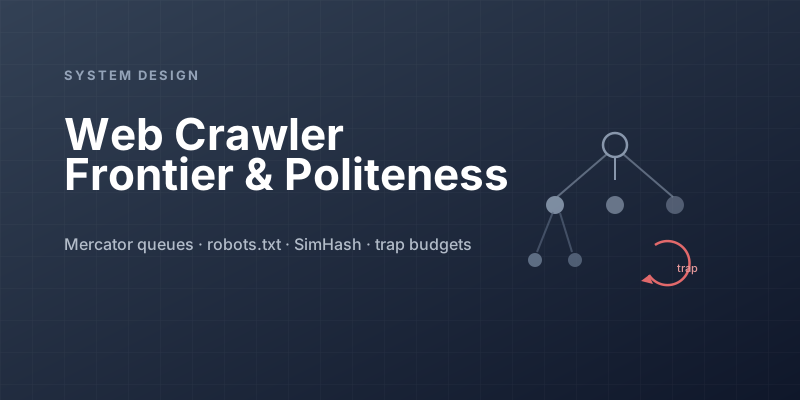
On the whiteboard, a web crawler is ten lines: pop URL from queue, fetch, parse, push discovered links, repeat. Every complication comes from one fact the pseudocode hides — the graph is adversarial. Sites throttle you, trap you in infinite calendars, mirror each other's content, and go down mid-fetch. The interview is not "can you do BFS"; it is "do you know what the web does to BFS."
Requirements
Crawl ~1B pages/month (≈400 pages/sec sustained, thousands at peak); refresh pages on freshness-driven schedules; never overwhelm any host (politeness is a hard constraint — an impolite crawler gets your IP range blocked and makes headlines); dedupe near-identical content; resume cleanly after crashes.
The frontier: two-level queues, not one
The URL frontier — the "what to fetch next" structure — is the heart. A single FIFO fails twice: it ignores priority (a news homepage deserves refresh every 10 minutes; a 2009 blog comment page, yearly), and it ignores politeness (a thousand workers popping URLs will happily hit the same host a thousand times at once).
The classic Mercator design that production crawlers still echo — two levels:
front queues (by priority):  F1..Fk   <- refresh scheduler + new URLs enter here
       biased sampler pulls from front queues
back queues (by host):       B1..Bn   <- EACH maps to exactly one host
       worker pops only from a back queue whose host-timer is ready
host timer: next_allowed_fetch[host] = last_fetch + delay(host)
One back queue per host, one in-flight request per host, plus a per-host delay (from robots.txt Crawl-delay, or adaptive: a slow-responding host gets longer gaps — response time is a load signal). Politeness stops being a distributed-coordination nightmare because each host is owned by one queue; shard hosts across crawler nodes (hash(host) mod N) and ownership stays local — no cross-node locks. Priority lives entirely at the front level: importance (PageRank-ish, change frequency, site authority) decides what enters back queues; politeness decides when it leaves.
Fetch and parse: the boring-looking 60%
DNS resolution at 400/sec needs its own caching resolver (public resolvers will rate-limit you into mystery failures). Fetchers are async-IO workers (thousands of concurrent connections per node, most time spent waiting on slow servers), with per-fetch timeouts, size caps (a "page" that streams 2GB is an attack or a mistake — cut at ~10MB), and content-type filtering before download via HEAD or early abort. Respect robots.txt (cached per host with TTL, checked before every enqueue-to-back-queue, not at discovery time — rules change). Parsed links get normalized aggressively — lowercase host, strip fragments and default ports, resolve relative paths, sort/strip tracking params — because every distinct string that means the same page multiplies your frontier.
Dedup: seen URLs and seen content are different problems
URL-seen test: "have I enqueued this URL before?" — billions of entries, hit on every discovered link (~50 links/page × 400 pages/sec = 20K checks/sec). A Bloom filter in memory is the textbook answer, with its known bargain: false positives mean you skip a URL you never actually saw (~0.1% of the web silently unexplored — acceptable), zero false negatives means no duplicate fetches. Persist the authoritative set in a disk KV store; the Bloom filter is the fast front.
Content dedup is harder: mirrors, CDNs, ?session= variants, and scraped copies mean ~30% of fetched pages duplicate content you already have. Exact-dup via content hash is trivial; near-dup (same article, different boilerplate) needs locality-sensitive fingerprints — SimHash: 64-bit fingerprints where similar documents differ in ≤3 bits, and Hamming-neighbor lookup via permuted tables. Detecting near-dups saves storage, saves index pollution, and — the reason it belongs in the crawler rather than the indexer — saves you from wasting frontier budget on mirror farms: dedup feeds back into prioritization.
Traps, and the freshness loop
Crawler traps are graphs that generate infinite URLs — calendars with a "next month" link forever, faceted search with combinatorial filters, session-ID paths. Defenses are budget-based, not clever: per-host URL caps and depth caps, URL-pattern repetition detectors (the 4,000th /calendar/2043/07/ page), and diminishing returns per host — if the last 500 pages from a host were near-dups or low-value, throttle its frontier entry rate. A crawler's most precious resource is fetch budget; traps are budget attacks.
Recrawl scheduling closes the loop: for each page, estimate change frequency from observed history (fetch, compare fingerprint, update a per-page Poisson-ish rate estimate), then schedule next fetch to balance staleness cost against budget. Pages that never change decay to yearly; volatile pages climb toward their host's politeness ceiling. Storage-wise, everything downstream (parsed text → indexer, link graph → rank computation) consumes the crawl as an append-only stream — the crawler's output is a log, and index building is a fold over it.
| Interview probe | Answer sketch |
|---|---|
| Coordinator dies? | Frontier is persistent (disk-backed queues + checkpointed host timers); fetch tasks idempotent — refetch is wasted work, not corruption |
| One host is 40% of your frontier? | That's the trap/skew signal — per-host budgets; frontier entry is prioritized globally, not FIFO |
| JavaScript-rendered pages? | Headless rendering costs 100× a plain fetch — a separate, budgeted rendering tier for pages that need it, chosen by heuristics/value |
| Why not one global rate limiter? | Politeness is per-host, and per-host ownership (queue-per-host, sharded by host) makes it coordination-free |
The mental model to leave with: a crawler is a scheduler wearing a fetcher's clothes. Fetching is commodity async IO; the system is the frontier — priority in, politeness out, budgets everywhere.
Keep reading

Write Skew: The Anomaly Snapshot Isolation Does Not Catch
Two transactions each read what the other writes, both commit, and an invariant dies. Snapshot isolation allows write skew — here is how to close the hole.

Designing a Shopping Cart: Price Snapshots, Merge, and No Inventory Hold
A cart is a per-user document, not a reservation. What to store on the line, how to merge an anonymous cart at login, and when the price is allowed to change.
Designing Snowflake-Style IDs: Ordering, Workers, and Clock Rollback
A 64-bit id from a timestamp, a worker number, and a per-millisecond sequence. How many you can issue, why the clock must not step backwards, and why JavaScript cannot hold one.
PostgreSQL 19 on October 29: WAIT for Read-Your-Writes, REPACK Without the Lock, and What Got Pulled
PostgreSQL 19 GA is scheduled for October 29, 2026. The WAIT command gives standbys read-your-writes, REPACK CONCURRENTLY replaces VACUUM FULL and CLUSTER, autovacuum goes parallel, and SQL/PGQ, online checksums, and FOR PORTION OF were reverted in Beta 4.
Idempotency Keys for Write APIs
How to make POST safe to retry: the key, the stored response, the race between two identical requests, and the expiry that forgets too soon.

Read-Your-Writes: The User Just Saved and the Read Replica Does Not Know
Why a write to the primary followed by a read from a replica shows stale data, and the practical ways to pin the next read without sending all traffic to the primary.
Newsletter
New posts, straight to your inbox
One email per post. No spam, no tracking pixels, unsubscribe anytime.
Comments
- No comments yet. Be the first.