Load Balancing Deep Dive: L4 vs L7, Power of Two Choices, and Subsetting
Load balancing gets one slide in most system design answers — a box labeled "LB" that sprays requests evenly. In production, that box is a stack of decisions that determine your tail latency more than most application code does: which layer balances, with what information, using which algorithm, across which subset of backends. The gap between "round-robin at the LB" and what Google/Meta-scale serving actually does is a full senior interview's worth of material.
The layers: L4 spreads connections, L7 spreads requests
L4 (transport) balancers route connections by 5-tuple hashing — no request parsing, millions of connections per node, often implemented as anycast VIPs + ECMP + consistent hashing (Maglev/Katran-style, in kernel or XDP). Cheap and blind: with HTTP/2 multiplexing many requests over few connections, per-connection balance can hide brutal per-request imbalance — two connections can carry wildly different loads to their pinned backends.
L7 (application) balancers parse requests and balance each one: per-request routing (path/header rules), retries, and — critically — per-request load awareness. The standard deployment is both: L4 at the edge to spread connections across an L7 fleet (the gateway/sidecar proxies), L7 making the real balancing decision per request. Saying "HTTP/2 broke L4-only balancing" and why is a strong early signal.
Algorithms: why P2C beats the clever ones
Round-robin ignores that requests and backends aren't uniform. Least-connections sounds smarter but has a classic pathology in distributed balancers: many independent LB nodes each pick their own least-loaded backend using slightly stale stats — and they all pick the same one, dogpiling it into a spike, then stampeding to the next (the "thundering herd of the informed"). Stale global knowledge synchronizes mistakes.
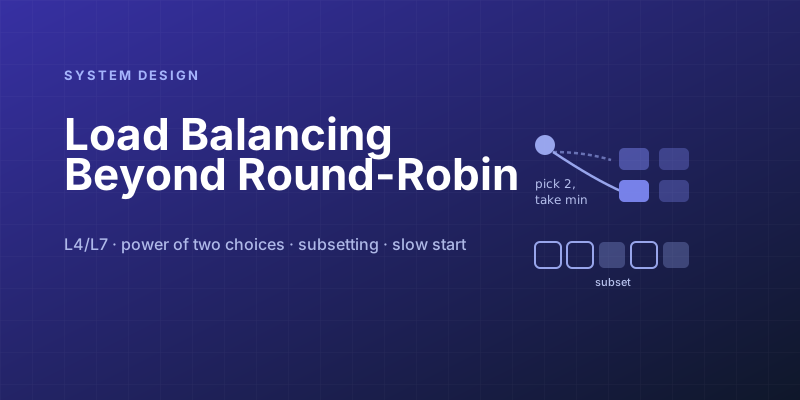
Power of two choices (P2C): pick two backends at random, send to the less loaded of the pair.
p2c: a, b = random(backends, 2)
     send to argmin(load(a), load(b))    # load = outstanding requests / EWMA latency
The randomness desynchronizes the balancers, so stale data can't cause dogpiles, while the "of two" comparison still steers sharply away from overload — the max-load bound improves exponentially over pure random with just that one extra sample. It's the default in Envoy and most modern meshes for exactly this reason: nearly the quality of global-knowledge balancing with none of its herd behavior. Load signal choice matters too: outstanding-requests (cheap, local) or latency-EWMA (catches degraded-but-accepting backends); both are local observations, which is the point.
Two refinements every large fleet adds: slow start (new/restarted backends ramp weight over ~30s — a cold JIT/cache instance receiving full share instantly is how deploys create latency spikes), and outlier ejection (a backend with anomalous error/latency gets temporarily removed — the circuit breaker as an LB-native feature, per-host).
Subsetting: when everyone can't talk to everyone
With 10K clients and 10K backends, full-mesh connection counts (10⁸) drown memory and health-check traffic. Deterministic subsetting gives each client a small subset (say 20-50 backends) chosen so that: subsets overlap minimally, every backend appears in ~equal numbers of subsets (else you've built imbalance), and churn (backend added/removed) reshuffles few assignments. Random-but-seeded shuffles per client group (the Google SRE-book construction) achieve this; naive "hash client to K backends" doesn't (uneven backend coverage). Subsetting interacts with P2C fine — you pick two within your subset — and with locality: zone-aware weighting keeps most traffic intra-zone for latency and egress cost, spilling cross-zone proportionally as local capacity degrades.
For stateful backends (caches especially), balancing flips to consistent-hash/ring routing — the LB's job becomes affinity (same key, same node) rather than evenness, with bounded-load consistent hashing capping how hot any node may get before spilling. Choosing "affinity vs evenness" per service is the design decision; there is no universal algorithm.
Health, and the herds hiding in it
Health checking is its own distributed systems problem: active probes (per-LB × per-backend — subsetting saves you here too), passive outlier detection from live traffic, and the panic threshold — when >X% of backends look unhealthy, stop trusting the health data and route to everything, because a correlated "everyone unhealthy" signal usually means the checker or a shared dependency is lying, and routing all traffic to the three "healthy" survivors kills them instantly (the load-shedding cousin of Lifeguard's "maybe I'm the problem"). Connection draining on deploys (finish in-flight, refuse new, then die) and retry budgets at the LB tier round out the failure choreography — the L7 balancer is where retries amplify or get contained.
| Interview probe | Answer sketch |
|---|---|
| Least-conn vs P2C, one line? | Global "best" + stale data = synchronized dogpiles; random two + local compare = desynchronized near-best — pick P2C |
| gRPC (long-lived HTTP/2) balancing? | Client-side L7 balancing via resolver/mesh (per-RPC picks), or L7 proxies; L4 alone pins whole channels to hosts |
| One backend at 90% CPU, others idle? | Check: hash affinity hotspot? subset imbalance? slow-start missing after deploy? — the diagnosis tree is the answer |
| DNS as the balancer? | TTL-bound staleness, no load signal, client disobedience — fine for coarse geo-steering (the CDN's job), never for backend evenness |
The distilled hierarchy: L4 spreads connections, L7 spreads requests; P2C with local load signals beats stale global cleverness; subsetting bounds the mesh; slow-start and panic thresholds tame the herds. Load balancing done well is invisible — which is exactly why it's worth being the candidate who can make it visible on a whiteboard.
Keep reading
Write Skew: The Anomaly Snapshot Isolation Does Not Catch
Two transactions each read what the other writes, both commit, and an invariant dies. Snapshot isolation allows write skew — here is how to close the hole.
Designing a Shopping Cart: Price Snapshots, Merge, and No Inventory Hold
A cart is a per-user document, not a reservation. What to store on the line, how to merge an anonymous cart at login, and when the price is allowed to change.
Designing Snowflake-Style IDs: Ordering, Workers, and Clock Rollback
A 64-bit id from a timestamp, a worker number, and a per-millisecond sequence. How many you can issue, why the clock must not step backwards, and why JavaScript cannot hold one.
PostgreSQL 19 on October 29: WAIT for Read-Your-Writes, REPACK Without the Lock, and What Got Pulled
PostgreSQL 19 GA is scheduled for October 29, 2026. The WAIT command gives standbys read-your-writes, REPACK CONCURRENTLY replaces VACUUM FULL and CLUSTER, autovacuum goes parallel, and SQL/PGQ, online checksums, and FOR PORTION OF were reverted in Beta 4.
Idempotency Keys for Write APIs
How to make POST safe to retry: the key, the stored response, the race between two identical requests, and the expiry that forgets too soon.
Read-Your-Writes: The User Just Saved and the Read Replica Does Not Know
Why a write to the primary followed by a read from a replica shows stale data, and the practical ways to pin the next read without sending all traffic to the primary.
Newsletter
New posts, straight to your inbox
One email per post. No spam, no tracking pixels, unsubscribe anytime.
Comments
- No comments yet. Be the first.