Microservices vs Monolith: Making the Right Architectural Choice
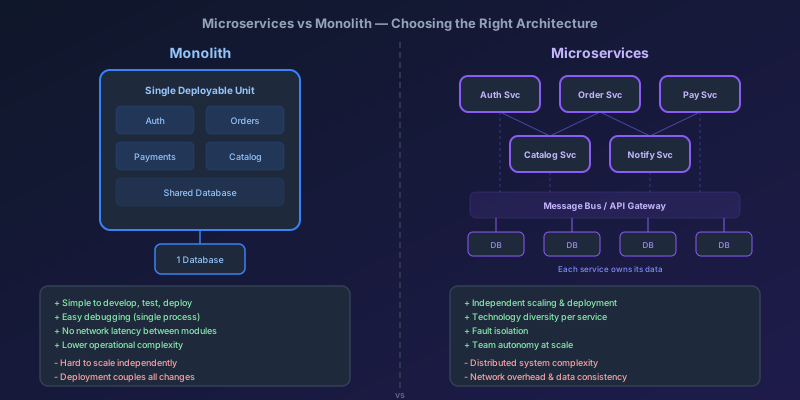
"We are moving to microservices" has become the default answer to every scaling problem, and it is often the wrong one. I have watched teams spend a year breaking apart a perfectly functional monolith — only to end up with a distributed monolith that is harder to debug, slower to deploy, and more expensive to operate.
The right architecture depends on your team, your product maturity, and your operational capabilities. This post will help you make that decision with clear eyes.
What Each Architecture Actually Means
The Monolith
A monolith is a single deployable unit where all application code lives together in one codebase, runs in one process, and connects to one (or a few) databases.
┌─────────────────────────────────────────────┐
│                 Monolith                     │
│  ┌─────────┐ ┌─────────┐ ┌───────────────┐ │
│  │  Auth    │ │ Orders  │ │   Payments    │ │
│  └─────────┘ └─────────┘ └───────────────┘ │
│  ┌─────────┐ ┌─────────┐ ┌───────────────┐ │
│  │ Catalog  │ │  Users  │ │ Notifications │ │
│  └─────────┘ └─────────┘ └───────────────┘ │
│  ┌─────────────────────────────────────────┐ │
│  │          Shared Database                 │ │
│  └─────────────────────────────────────────┘ │
└─────────────────────────────────────────────┘
This does not mean spaghetti code. A well-structured monolith has clear module boundaries, separated concerns, and defined interfaces between components. The key distinction is deployment: everything ships together.
Microservices
Microservices decompose your application into independently deployable services, each owning a specific business capability. Each service:
- Runs in its own process (often its own container)
- Owns its own data store
- Communicates with other services over the network (HTTP, gRPC, messaging)
- Can be deployed, scaled, and developed independently
┌─────────┐  ┌─────────┐  ┌─────────┐  ┌─────────┐
│Auth Svc  │  │Order Svc│  │Pay Svc  │  │Catalog  │
│  ┌───┐   │  │  ┌───┐  │  │  ┌───┐  │  │  ┌───┐  │
│  │DB │   │  │  │DB │  │  │  │DB │  │  │  │DB │  │
│  └───┘   │  │  └───┘  │  │  └───┘  │  │  └───┘  │
└────┬─────┘  └───┬─────┘  └───┬─────┘  └───┬─────┘
     │            │             │             │
─────┴────────────┴─────────────┴─────────────┴──────
              Message Bus / API Gateway
The promise is that each team can move independently. The cost is that you are now building a distributed system.
The Monolith Is Not the Enemy
There is a pervasive myth in our industry that monoliths are inherently bad and microservices are inherently good. This is wrong.
Shopify runs one of the largest e-commerce platforms in the world on a modular monolith. Stack Overflow serves millions of developers from a monolith. Basecamp has run a monolith successfully for over two decades.
The problems people attribute to monoliths are usually problems of poor code organization, not architecture:
- "Deployments are scary" → You have insufficient testing, not an architecture problem
- "The codebase is a mess" → Your module boundaries are unclear, splitting into services will not fix that
- "We cannot scale" → Have you tried horizontal scaling of the monolith first? It is far simpler
- "Teams step on each other" → Define module ownership boundaries within the monolith
When the Monolith Wins
Small to Medium Teams (< 30-50 engineers)
The overhead of microservices — service discovery, distributed tracing, circuit breakers, API versioning, independent CI/CD pipelines — is enormous. A team of 10 engineers maintaining 15 microservices is spending more time on infrastructure than features.
Rule of thumb: If your team can fit in a single meeting room, a monolith is almost certainly the right choice.
New Products with Unclear Domain Boundaries
When you are building something new, you do not know where the right service boundaries are. Getting boundaries wrong in a microservices architecture is extremely expensive — data that should live together ends up split across services, creating a cascade of cross-service calls and distributed transactions.
A monolith lets you iterate on boundaries cheaply. Renaming a module is easy. Moving code between packages is easy. Splitting a database table is hard regardless, but it is harder when the data lives in different services.
When Speed to Market Matters
A monolith has lower overhead for:
- Local development (one service to start, one database to seed)
- Testing (no inter-service communication to mock)
- Deployment (one artifact to build and ship)
- Debugging (one process with stack traces that tell the full story)
In the early stages, shipping features fast matters more than architectural purity.
When Your Team Lacks Operational Maturity
Microservices require robust operational capabilities:
- Container orchestration (Kubernetes or similar)
- Centralized logging (ELK, Datadog, etc.)
- Distributed tracing (Jaeger, Zipkin)
- Service mesh or API gateway
- Automated CI/CD per service
- Health checks, circuit breakers, retries
If your team is not comfortable operating these systems, microservices will slow you down dramatically. Master operations first, then consider the transition.
When Microservices Win
Large Organizations (50+ engineers)
When you have 10+ teams working on the same product, a monolith creates coordination bottlenecks:
- Merge conflicts increase exponentially with team count
- A broken test in the auth module blocks the catalog team's deploy
- Release coordination meetings become a weekly ritual
- Shared libraries become contested territory
Microservices let teams deploy independently. The auth team ships on Monday, the catalog team ships on Thursday, and neither needs the other's approval. Conway's Law works in your favor: your architecture mirrors your organizational structure.
Independent Scaling Requirements
If your search service handles 100x the traffic of your admin dashboard, you should not have to scale both together. Microservices let you:
- Scale the search service to 50 instances while the admin runs on 2
- Choose different instance types (compute-optimized for search, memory-optimized for caching)
- Apply different auto-scaling policies based on each service's load patterns
Polyglot Requirements
Some problems are best solved with specific technologies:
- Real-time notifications: Go or Elixir for high-concurrency WebSockets
- Machine learning pipeline: Python with TensorFlow/PyTorch
- CRUD APIs: Whatever your team knows best
- Stream processing: Java/Scala with Kafka Streams
Microservices let each team pick the best tool without forcing the entire organization into one technology stack.
Fault Isolation
In a monolith, a memory leak in the image processing module can bring down the entire application. In a microservices architecture, the image processing service crashes and restarts while order processing continues normally.
This is particularly important for services with different reliability requirements. Your payment processing should not be affected by a bug in your recommendation engine.
The Modular Monolith: The Middle Ground
A modular monolith gives you many of the organizational benefits of microservices without the distributed system complexity. The idea is simple: enforce module boundaries within a single deployable unit.
Structure
src/
├── modules/
│   ├── auth/
│   │   ├── api/          # Public interface (what other modules can call)
│   │   ├── internal/     # Private implementation
│   │   ├── domain/       # Domain models
│   │   └── persistence/  # Data access
│   ├── orders/
│   │   ├── api/
│   │   ├── internal/
│   │   ├── domain/
│   │   └── persistence/
│   ├── catalog/
│   │   ├── api/
│   │   ├── internal/
│   │   ├── domain/
│   │   └── persistence/
│   └── payments/
│       ├── api/
│       ├── internal/
│       ├── domain/
│       └── persistence/
└── shared/               # Truly shared code (logging, config)
Enforcement Rules
The critical difference from a "well-organized monolith" is that boundaries are enforced, not just suggested:
- Modules communicate only through their public API layer — no reaching into another module's internals
- Each module owns its own tables — no direct SQL joins across module boundaries
- Cross-module communication uses defined interfaces — events, function calls through the API layer
- Architecture tests enforce these rules — ArchUnit (Java), dependency-cruiser (JS), or custom linting
// Architecture test example (ArchUnit for Java):
@Test
void moduleBoundariesAreRespected() {
    noClasses()
        .that().resideInAPackage("..orders.internal..")
        .should().beAccessedByAnyPackage("..catalog..", "..payments..")
        .check(importedClasses);
}
Why This Works
The modular monolith is the default recommendation of Domain-Driven Design practitioners, and for good reason:
- Extraction is straightforward: When you actually need to pull a module into its own service, the boundaries are already clean. It becomes a mechanical operation rather than an archaeological expedition.
- Refactoring is cheap: Moving code between modules within a monolith is a refactor. Moving code between microservices is a migration.
- You get team autonomy: Different teams can own different modules with clear interfaces, without the operational overhead.
Service Boundaries and Domain-Driven Design
Whether you choose microservices or a modular monolith, defining boundaries is the most consequential design decision. Get boundaries wrong, and everything else fails.
Bounded Contexts
DDD's concept of "bounded contexts" maps directly to service (or module) boundaries. A bounded context is a boundary within which a specific domain model applies consistently.
Consider an e-commerce platform. The concept of "Product" means different things in different contexts:
- Catalog context: Product has a name, description, images, categories, SEO metadata
- Inventory context: Product (as SKU) has quantity, warehouse location, reorder threshold
- Pricing context: Product has base price, discount rules, currency, tax classification
- Shipping context: Product has weight, dimensions, shipping class, hazmat flags
Each context should own its own representation of a product. Trying to create a single unified "Product" model that serves all contexts leads to a bloated, coupled design.
Identifying Boundaries
Here are practical signals for finding boundaries:
- Language changes: When the same word means different things to different teams, that is a boundary
- Data ownership: If two features need to mutate the same data simultaneously, they likely belong together
- Change frequency: Features that change together should live together
- Team structure: Boundaries should enable team independence (Conway's Law again)
The Entity Trap
The most common boundary mistake is splitting by entity:
BAD: Service-per-entity
├── UserService
├── OrderService
├── ProductService
├── PaymentService
└── ShipmentService
This creates a distributed data model, not independent services. Creating an order now requires orchestrating calls to UserService, ProductService, PaymentService, and ShipmentService in the right sequence. You have all the complexity of microservices with none of the independence.
BETTER: Service-per-capability
├── OrderFulfillment (owns orders, inventory allocation, shipment)
├── ProductCatalog (owns products, categories, search)
├── CustomerManagement (owns users, preferences, addresses)
└── Billing (owns payments, invoices, refunds)
Data Ownership
The hardest part of microservices is data. In a monolith, you have one database and can join any tables you need. In microservices, each service owns its data, and you must navigate these constraints.
The Rules
- Each service owns its data exclusively — no other service reads from or writes to your database directly
- No cross-service database joins — if you need data from another service, call its API
- Eventual consistency is the default — accept that data across services will not always be perfectly in sync
Patterns for Handling Cross-Service Data
API Composition: For read queries that need data from multiple services, an API gateway or BFF (Backend for Frontend) calls each service and merges the results.
Client → API Gateway → [Order Service: get order details]
                     → [Customer Service: get customer info]
                     → [Product Service: get product names]
                     → Compose response → Client
Event-Driven Data Replication: Services publish events when their data changes. Other services maintain a local read-optimized copy of the data they need.
Order Service: "OrderPlaced" event →
  → Shipping Service: stores order details locally for fulfillment
  → Analytics Service: stores order for reporting
  → Notification Service: sends confirmation email
Saga Pattern: For operations that span multiple services and need to maintain consistency, use a saga — a sequence of local transactions coordinated by events.
1. Order Service: Create order (PENDING)
2. Payment Service: Charge payment → success
3. Inventory Service: Reserve stock → success
4. Order Service: Confirm order (CONFIRMED)

If step 3 fails:
3b. Payment Service: Refund payment (compensating transaction)
3c. Order Service: Cancel order (CANCELLED)
Communication Patterns
Synchronous (Request-Response)
HTTP/REST or gRPC — Service A calls Service B and waits for a response.
Pros:
- Simple mental model
- Immediate consistency
- Easy to debug (request → response)
Cons:
- Tight temporal coupling — both services must be running
- Cascading failures — if Service B is slow, Service A is slow
- Latency accumulates through the call chain
When to use: Reading data from another service, operations where you need an immediate answer.
Asynchronous (Event-Driven)
Message queues (RabbitMQ, SQS) or event streams (Kafka) — Service A publishes an event, Service B processes it whenever it can.
Pros:
- Temporal decoupling — services do not need to be online simultaneously
- Natural buffering — spikes in traffic get absorbed by the queue
- Better fault tolerance — if Service B is down, messages wait in the queue
Cons:
- Eventual consistency — harder to reason about
- Debugging is harder (events flow through queues, not direct call stacks)
- Message ordering, deduplication, and dead letter handling add complexity
When to use: Notifications, data synchronization, any operation where the caller does not need an immediate result.
The Pragmatic Mix
Most production systems use both. A common pattern:
- Synchronous for reads and operations requiring immediate feedback
- Asynchronous for side effects, notifications, and cross-service data updates
User places order:
1. [Sync] API Gateway → Order Service: create order, validate stock
2. [Sync] Order Service → Payment Service: charge card
3. [Async] Order Service publishes "OrderConfirmed" event
4. [Async] Shipping Service picks up event, begins fulfillment
5. [Async] Email Service picks up event, sends confirmation
Operational Complexity: The Reality Check
Here is what microservices actually require in production that a monolith does not:
Observability
| Concern | Monolith | Microservices |
|---|---|---|
| Logging | One log stream | Centralized log aggregation (ELK, Datadog) |
| Tracing | Stack traces | Distributed tracing (correlation IDs across services) |
| Metrics | Application metrics | Per-service metrics + cross-service dashboards |
| Debugging | Attach debugger | Correlate logs across 5+ services |
Deployment
| Concern | Monolith | Microservices |
|---|---|---|
| CI/CD | 1 pipeline | N pipelines (one per service) |
| Versioning | One version | API contracts between services |
| Rollback | Roll back one artifact | Coordinate compatible versions |
| Testing | One test suite | Contract tests + integration tests |
Infrastructure
| Concern | Monolith | Microservices |
|---|---|---|
| Service discovery | Not needed | Consul, Kubernetes DNS, or similar |
| Load balancing | One load balancer | Per-service load balancing |
| Networking | Localhost calls | Service mesh, network policies |
| Secrets | One config file | Per-service secret management |
Honest assessment: If you are a startup with 5 engineers and you choose microservices, you are spending 40-60% of your engineering time on infrastructure instead of features. That is a losing trade.
Migration Strategies
If you have decided that microservices are the right move, here is how to get there without a rewrite.
The Strangler Fig Pattern
The safest migration strategy. Named after the strangler fig tree that grows around an existing tree and eventually replaces it.
- Identify a bounded context in your monolith to extract
- Build the new service alongside the monolith
- Route traffic to the new service for that capability (using a reverse proxy or feature flags)
- Remove the old code from the monolith once the new service is stable
- Repeat with the next bounded context
Phase 1: Monolith handles everything
   [Client] → [Monolith (Auth + Orders + Payments)]

Phase 2: Extract Auth, proxy traffic
   [Client] → [Proxy] → [Auth Service]
                       → [Monolith (Orders + Payments)]

Phase 3: Extract Payments
   [Client] → [Proxy] → [Auth Service]
                       → [Payment Service]
                       → [Monolith (Orders)]
Key Migration Principles
- Extract the simplest, most independent module first — build confidence before tackling the hard ones
- Keep the database shared initially — split the database after the service is stable. Two big changes at once is a recipe for disaster
- Use feature flags — route a percentage of traffic to the new service and increase gradually
- Maintain backward compatibility — the monolith and new service should both work during the transition
- Accept that migration takes months or years — this is not a sprint, it is a strategic investment
The Decision Framework
Here is a practical checklist for making the decision:
Choose a monolith when:
- Your team is smaller than 30 engineers
- You are building a new product and domain boundaries are unclear
- Speed to market is the top priority
- Your team does not have strong DevOps capabilities
- Your product has a single, well-defined scaling profile
Choose a modular monolith when:
- You have 15-50 engineers
- You want team autonomy without distributed system complexity
- You anticipate needing microservices in the future but not today
- You want clean boundaries that make future extraction possible
Choose microservices when:
- You have 50+ engineers across multiple teams
- Different components have genuinely different scaling needs
- You need polyglot technology (different languages/frameworks per service)
- Your team has strong operational maturity (Kubernetes, observability, CI/CD)
- You have clear, stable domain boundaries
Summary
The architecture decision is fundamentally about organizational scalability, not technical scalability. A monolith can handle enormous traffic (just look at Stack Overflow). Microservices solve the problem of many teams shipping independently on the same product.
Start with a well-structured monolith. Enforce module boundaries. When you genuinely hit the organizational scaling wall — when deployment coordination becomes a bottleneck and teams cannot move independently — extract services along the boundaries you have already defined.
The worst outcome is choosing microservices because it sounds modern, only to discover that you have traded simple in-process function calls for a complex distributed system that your team does not know how to operate. Architecture should solve your actual problems, not the problems you hope to have someday.
Keep reading

Write Skew: The Anomaly Snapshot Isolation Does Not Catch
Two transactions each read what the other writes, both commit, and an invariant dies. Snapshot isolation allows write skew — here is how to close the hole.

Designing a Shopping Cart: Price Snapshots, Merge, and No Inventory Hold
A cart is a per-user document, not a reservation. What to store on the line, how to merge an anonymous cart at login, and when the price is allowed to change.
Designing Snowflake-Style IDs: Ordering, Workers, and Clock Rollback
A 64-bit id from a timestamp, a worker number, and a per-millisecond sequence. How many you can issue, why the clock must not step backwards, and why JavaScript cannot hold one.

PostgreSQL 19 on October 29: WAIT for Read-Your-Writes, REPACK Without the Lock, and What Got Pulled
PostgreSQL 19 GA is scheduled for October 29, 2026. The WAIT command gives standbys read-your-writes, REPACK CONCURRENTLY replaces VACUUM FULL and CLUSTER, autovacuum goes parallel, and SQL/PGQ, online checksums, and FOR PORTION OF were reverted in Beta 4.

Idempotency Keys for Write APIs
How to make POST safe to retry: the key, the stored response, the race between two identical requests, and the expiry that forgets too soon.

Read-Your-Writes: The User Just Saved and the Read Replica Does Not Know
Why a write to the primary followed by a read from a replica shows stale data, and the practical ways to pin the next read without sending all traffic to the primary.
Newsletter
New posts, straight to your inbox
One email per post. No spam, no tracking pixels, unsubscribe anytime.
Comments
- No comments yet. Be the first.