Multi-Region Active-Active: Patterns for Serving Writes from Everywhere
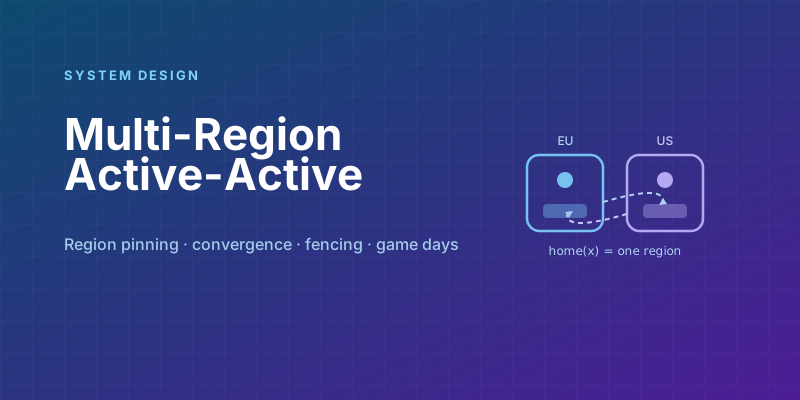
Multi-region starts as a checkbox ("we need DR") and becomes a philosophy exam the moment someone asks: if both regions accept writes, what happens when they disagree? Active-passive dodges the question and pays for it — an idle region that costs full price, and a failover path exercised only during real disasters, which is why it fails. Active-active answers the question deliberately, and the answer is never "we handle conflicts everywhere"; it's a portfolio of per-data-class decisions. That portfolio is the staff-level interview.
The taxonomy: where does a write's truth live?
Pattern 1 — Partitioned ownership (region pinning). Every entity gets a home region (user's geography, tenant's residency); writes for it route home, other regions hold read replicas. Both regions are fully active — for different subsets. Conflicts are impossible by construction because each datum has one writer region.
user in EU -> EU region owns their writes; US serves their reads (async replica)
routing: edge/gateway consults entity->home mapping (config/directory)
The costs: a traveling user (or cross-entity operation) pays cross-region latency to their home; the entity→region directory is now critical infrastructure; and rehoming (migrating an entity's ownership — for a move, or a regional evacuation) is a real protocol: freeze-drain-flip with fencing (epoch per entity, storage rejects stale-epoch writers), the distributed-locking playbook applied at region grain. This is the workhorse pattern — most "active-active" systems are region-pinned underneath, and B2B/data-residency requirements push the same shape anyway.
Pattern 2 — True multi-writer with convergence. Any region accepts any write; replication is async and bidirectional; conflicts are expected and resolved by data design: CRDTs and version vectors where merge semantics exist (carts, presence, counters — the Dynamo lineage), LWW where losing a write is genuinely acceptable, and application-level merge queues for the rest. Reserve this for data that has a safe merge — and say explicitly that uniqueness invariants (usernames, payments, inventory) cannot live here.
Pattern 3 — Consensus-spanning (Spanner-class). Synchronous quorums across regions: real global consistency, write latency = inter-region RTT, cost = running the quorum everywhere. Reserved for the small core that truly needs global linearizable writes — the config plane, the ledger of record — not the request path at large.
The senior move is refusing to pick one: classify data, assign each class a pattern. Sessions → multi-writer CRDT-ish; user content → region-pinned; payment ledger → single-home (or consensus); derived caches → rebuild locally per region.
The unglamorous 80%: routing, replication lag, and drills
Routing is where active-active succeeds or dies: geo-DNS/anycast steers users to the nearest healthy region, but stickiness matters more than nearness — a user bouncing between regions mid-session experiences every replication lag as a bug (write in US, refresh hits EU, post "vanished"). Session affinity to the write path + read-your-writes tokens (session guarantees, deployed at planetary scale) paper over async replication for the author; everyone else's staleness is declared acceptable per data class. Cross-region replication is a product surface, not plumbing: lag is monitored per class with SLOs, and the event backbone (Kafka mirroring / CDC streams) carries ordering caveats — per-key order survives mirroring, global order doesn't; design consumers accordingly.
Failover is a practiced operation, not a wiki page. Evacuating a region means: flip routing weights (gradual, not cliff), rehome pinned entities (or accept their unavailability — say which), let multi-writer classes just keep going (their whole point), and fence the sick region so a zombie (partitioned-but-alive, still processing queued writes) can't split-brain — epoch bump distributed via the config plane, storage and consumers reject the old epoch. The teams that survive real regional outages are the ones running game days: scheduled evacuations of production traffic, because a failover path that isn't exercised monthly is fiction. Capacity math follows: N regions must each carry the load of N-1 failing (2 regions = each runs below 50% — active-active's "efficiency" is partly an illusion you budget honestly).
And the quiet prerequisite for all of it: regional isolation — each region a self-sufficient stack (its own caches, queues, DBs, dependencies), cross-region calls forbidden on the request path. Most "multi-region" outages are one region synchronously calling another because someone took a shortcut; blast-radius discipline is what makes the patterns above meaningful.
| Interview probe | Answer sketch |
|---|---|
| Global unique username at signup? | The one linearizable moment: single-home the claim (global uniqueness service / consensus), then pin the user; don't make the whole user multi-writer for one constraint |
| User flies from EU to US? | Reads go local (replica), writes go home (latency, hidden by async UX) or trigger rehoming after a stability window |
| Replication link severed 10 minutes? | Pinned classes: remote reads stale, home writes fine. Multi-writer: divergence accrues, converges on heal — inventory-like data must not be in this class |
| How do you test conflict handling? | Chaos: inject partition + concurrent writes in staging with production topology; conflicts you've never manufactured are conflicts you can't survive |
The distilled doctrine: classify data by its merge-ability and invariants; pin what can't merge, converge what can, consensus the tiny core that needs the world to agree; make regions islands; and rehearse the evacuation until it's boring. Multi-region isn't a topology — it's a set of promises, kept per data class.
Keep reading
Write Skew: The Anomaly Snapshot Isolation Does Not Catch
Two transactions each read what the other writes, both commit, and an invariant dies. Snapshot isolation allows write skew — here is how to close the hole.
Designing a Shopping Cart: Price Snapshots, Merge, and No Inventory Hold
A cart is a per-user document, not a reservation. What to store on the line, how to merge an anonymous cart at login, and when the price is allowed to change.
Designing Snowflake-Style IDs: Ordering, Workers, and Clock Rollback
A 64-bit id from a timestamp, a worker number, and a per-millisecond sequence. How many you can issue, why the clock must not step backwards, and why JavaScript cannot hold one.
PostgreSQL 19 on October 29: WAIT for Read-Your-Writes, REPACK Without the Lock, and What Got Pulled
PostgreSQL 19 GA is scheduled for October 29, 2026. The WAIT command gives standbys read-your-writes, REPACK CONCURRENTLY replaces VACUUM FULL and CLUSTER, autovacuum goes parallel, and SQL/PGQ, online checksums, and FOR PORTION OF were reverted in Beta 4.
Idempotency Keys for Write APIs
How to make POST safe to retry: the key, the stored response, the race between two identical requests, and the expiry that forgets too soon.

Read-Your-Writes: The User Just Saved and the Read Replica Does Not Know
Why a write to the primary followed by a read from a replica shows stale data, and the practical ways to pin the next read without sending all traffic to the primary.
Newsletter
New posts, straight to your inbox
One email per post. No spam, no tracking pixels, unsubscribe anytime.
Comments
- No comments yet. Be the first.