SWIM, Gossip, and Phi-Accrual: How Clusters Know Who's Alive
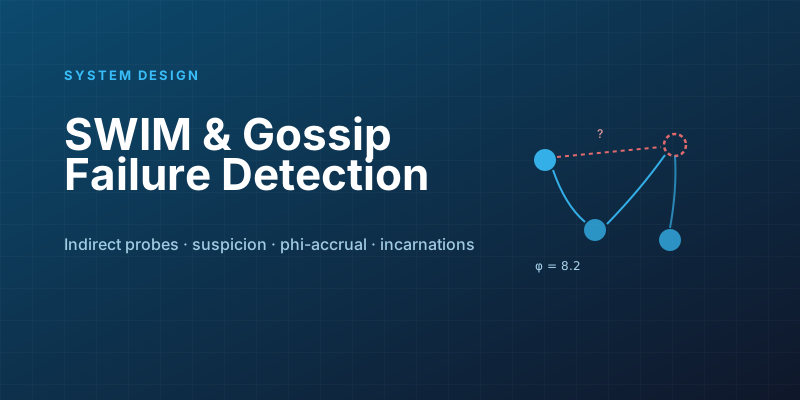
Every distributed system contains a quiet embarrassment: it cannot actually tell whether a machine is dead. A silent node might be crashed, GC-paused, partitioned, or just slow — and no amount of waiting distinguishes them (that impossibility is the FLP result's street form). Yet every membership decision — reroute traffic, promote a replica, rebalance shards — hangs on exactly this undecidable question. Failure detection is the load-bearing guess under everything else, and its design space — heartbeats, SWIM, phi-accrual — shows up verbatim inside Cassandra, Consul, Serf, Akka, and every service mesh.
Why all-to-all heartbeats die first
The naive scheme — everyone pings everyone every second — costs O(N²) messages per period: at 1,000 nodes, a million pings/sec of pure overhead, and each node maintaining timeout state for 999 peers. Centralizing it (everyone heartbeats a monitor) restores O(N) but builds a single point whose own failure is indistinguishable from everyone's, plus a blast-radius problem when it flaps. The scaling law you want: per-node load constant in cluster size, detection time growing at most logarithmically.
SWIM: constant load, probabilistic completeness
SWIM's protocol period, per node, regardless of cluster size:
every T (say 1s), node A:
  1. pick ONE random member B; ping it
  2. no ack within timeout? ask k others (say 3): "ping B for me"
     -> indirect probes: any of them reach B, A gets an ack relayed
  3. still nothing? mark B SUSPECT (not dead) and gossip that
  4. suspect survives a timeout without refutation -> CONFIRMED dead
Each ingredient kills a specific false-positive class. Random probing spreads detection duty with no coordination — every member gets probed in expectation each period across the cluster. Indirect probes (step 2) are the subtle one: they distinguish "B is down" from "the A↔B path is down" — a partial network partition stops being a death sentence pronounced by whoever happens to sit behind the bad link. Suspicion (step 3) inserts a refutation window: B, seeing itself gossiped as suspect, broadcasts an incarnation-numbered "I'm alive" that overrides the suspicion. GC pauses and CPU stalls get to un-condemn themselves.
Membership updates travel by piggybacked gossip — no extra messages; updates ride along on pings and acks, reaching everyone in O(log N) periods with high probability. Incarnation numbers (bumped only by the accused node refuting its own suspicion) give updates a total order per member, so a stale "alive" can never resurrect a confirmed death — the same monotonic-epoch trick as fencing tokens, applied to identity.
Phi-accrual: suspicion as a float, not a bit
The orthogonal refinement (Cassandra's detector): binary timeouts encode one arbitrary threshold, but inter-arrival times of heartbeats have a distribution. Phi-accrual keeps a sliding window of recent inter-arrival times and outputs a continuous suspicion level — φ = -log₁₀(P(silence this long | history)) — so φ=1 means "10% chance this silence is normal," φ=8 means one-in-10⁸.
The two design consequences: thresholds become per-link and adaptive (a node across a jittery WAN link earns a wider tolerance than a rack neighbor, automatically), and different consumers apply different thresholds to the same signal — routing might dodge a node at φ=3 while replica promotion waits for φ=10. Detection stops being a global verdict and becomes a risk dial each subsystem reads at its own tolerance. That split — cheap evidence collection, per-consumer decision — is the transferable pattern.
Lifeguard: the slow node problem
HashiCorp's production scars (Serf/Consul) produced Lifeguard, whose insight inverts the frame: many "failure detections" are caused by the detector being sick, not the target. An overloaded node times out everyone it probes and floods the cluster with false accusations. Lifeguard's fixes: a node that isn't receiving expected acks about itself widens its own probe timeouts (self-awareness: "maybe I'm the problem"); suspicion timeouts scale with how many independent accusers exist (one accuser = long fuse, five = short). False positives drop ~50× with negligible extra cost. The meta-lesson generalizes to any monitoring you build: an unhealthy observer is indistinguishable from an unhealthy observed — good detectors model their own degradation.
Where the guess becomes truth
Gossip-based membership is eventually agreed, probabilistically fast — perfect for routing tables, load balancing, hinted-handoff targets. It is not a basis for safety-critical exclusivity: "the cluster thinks node X is dead" must never by itself authorize taking X's locks or splitting its shard, because X may disagree and still be writing. Safety comes from pairing the detector with leases and fencing tokens (X's authority expires on a clock X itself respects; storage rejects stale-epoch writers) or from running membership through consensus (Raft-managed member lists) where changes are rare and correctness-critical. The layering to say out loud: gossip detection for liveness reactions, epochs/leases for safety; systems that let the first drive the second directly have a split-brain story waiting to run.
| Interview probe | Answer sketch |
|---|---|
| Detection time vs false positives? | The fundamental dial — shorter timeouts detect faster and accuse wrongly more; phi-accrual makes the dial explicit and adaptive |
| Node flapping up/down? | Incarnation numbers order the gossip; add hysteresis (rejoin cooldown) so flappers don't churn shard placement |
| 10K nodes? | SWIM load is constant per node; gossip convergence O(log N) — the thing that breaks first is humans reading membership churn, so batch/dampen updates |
| Why did Consul/Cassandra pick these? | Because they're leaderless: membership must work before and during any election — the detector can't depend on what it enables |
The distilled hierarchy: random probing for constant load, indirect probes for path-vs-node discrimination, suspicion windows for refutation, continuous suspicion for adaptive thresholds, self-awareness for sick observers, and epochs so the whole probabilistic apparatus never gets to overrule safety. Each layer exists because the previous one, alone, condemned an innocent machine.
Keep reading
Write Skew: The Anomaly Snapshot Isolation Does Not Catch
Two transactions each read what the other writes, both commit, and an invariant dies. Snapshot isolation allows write skew — here is how to close the hole.

Designing a Shopping Cart: Price Snapshots, Merge, and No Inventory Hold
A cart is a per-user document, not a reservation. What to store on the line, how to merge an anonymous cart at login, and when the price is allowed to change.
Designing Snowflake-Style IDs: Ordering, Workers, and Clock Rollback
A 64-bit id from a timestamp, a worker number, and a per-millisecond sequence. How many you can issue, why the clock must not step backwards, and why JavaScript cannot hold one.
PostgreSQL 19 on October 29: WAIT for Read-Your-Writes, REPACK Without the Lock, and What Got Pulled
PostgreSQL 19 GA is scheduled for October 29, 2026. The WAIT command gives standbys read-your-writes, REPACK CONCURRENTLY replaces VACUUM FULL and CLUSTER, autovacuum goes parallel, and SQL/PGQ, online checksums, and FOR PORTION OF were reverted in Beta 4.
Idempotency Keys for Write APIs
How to make POST safe to retry: the key, the stored response, the race between two identical requests, and the expiry that forgets too soon.
Read-Your-Writes: The User Just Saved and the Read Replica Does Not Know
Why a write to the primary followed by a read from a replica shows stale data, and the practical ways to pin the next read without sending all traffic to the primary.
Newsletter
New posts, straight to your inbox
One email per post. No spam, no tracking pixels, unsubscribe anytime.
Comments
- No comments yet. Be the first.