Designing Webhook Delivery That Survives Flaky Consumers
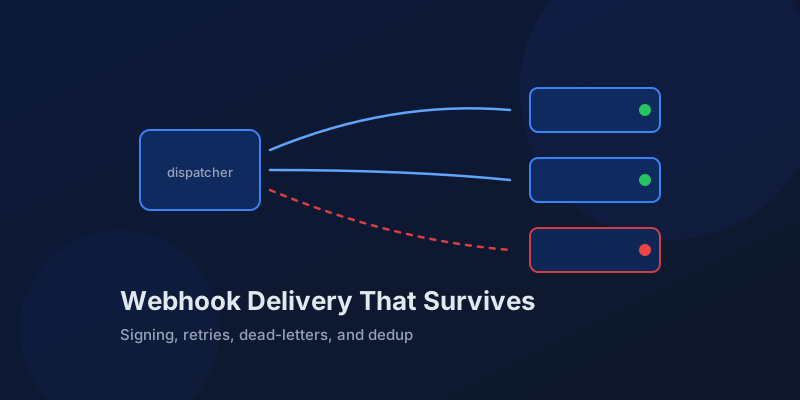
Webhooks look like the easy half of an API: you just POST JSON at a URL the customer gave you. Then the customer's endpoint times out during their deploy, returns 200 while dropping the payload, or gets called twice and double-fulfills an order. Every mature webhook system — Stripe, GitHub, Shopify — converges on the same handful of design decisions, because the naive version fails the same ways every time.
Deliver from a queue, never from the request path
The event producer should never wait on a customer's server. When the triggering action happens, write the event and enqueue a delivery job; a separate dispatcher pool makes the HTTP calls. A consumer that takes 30 seconds to respond should cost you one worker slot, not a database transaction or a user-facing request.
action → event store → delivery queue → dispatcher → consumer endpoint
                          ↑ retries re-enqueue here
Give the call a tight timeout — 5 to 10 seconds is typical — and treat a timeout exactly like a 5xx. On the consumer side the matching advice: acknowledge fast, process async. An endpoint that does real work inline will eventually exceed the timeout and get retried into double-processing.
Retry with backoff, then dead-letter
Failures are normal, so the schedule matters more than the intent. Retry on 5xx, 429, and timeouts with exponential backoff and jitter, spread over hours to ride out deploys and incidents. Do not retry 4xx responses other than 429 — a 404 or 401 will not fix itself, and hammering it just fills your logs.
| Attempt | Delay | Cumulative |
|---|---|---|
| 1 | immediate | 0 |
| 2 | 1 min | 1 min |
| 3 | 15 min | ~16 min |
| 4 | 2 h | ~2 h |
| 5 | 12 h | ~14 h |
| 6 | 24 h | ~38 h |
After the last attempt, dead-letter — do not delete. Keep exhausted deliveries queryable, expose them in a dashboard, and offer manual or API-driven redelivery. Automatically disabling an endpoint that has failed for days (with an email to the owner) protects your dispatchers and is a feature customers thank you for, provided reactivation is self-service.
Sign every delivery and make replays detectable
A webhook endpoint is a public URL that accepts POSTs, so authenticity is your problem. Sign the payload with a per-endpoint secret and put the signature and a timestamp in headers. Consumers verify with a constant-time comparison and reject stale timestamps to block replay.
import hashlib, hmac, time

def verify(payload: bytes, timestamp: str, signature: str, secret: str) -> bool:
    if abs(time.time() - int(timestamp)) > 300:
        return False
    signed = f"{timestamp}.".encode() + payload
    expected = hmac.new(secret.encode(), signed, hashlib.sha256).hexdigest()
    return hmac.compare_digest(expected, signature)
Sign the raw bytes you send, and tell consumers to verify the raw bytes they receive — JSON re-serialization is the classic verification bug. Support two active secrets per endpoint so customers can rotate without downtime.
Duplicates and ordering are the consumer's contract
At-least-once delivery means duplicates, so say it out loud. Give every event a unique ID, put it in the payload and headers, and document that consumers must deduplicate. A consumer that records processed event IDs handles both your retries and their own replays.
Do not promise ordering. Retries alone destroy it: event 42 fails and retries in an hour, event 43 delivers now. Instead, put a sequence number or updated timestamp on the resource so consumers can discard stale events, and design payloads so the latest event wins.
There is a related choice in payload design: thin events (order.updated, an ID, fetch the rest via API) versus fat events (full resource embedded). Thin payloads make stale data impossible and shrink the security surface; fat payloads save the read call. Stripe ships fat, many systems ship thin — either works if you are consistent, but thin payloads make the ordering problem mostly disappear.
Observability turns webhook support tickets into dashboards
Every delivery attempt should be a queryable record: event ID, endpoint, attempt number, status code, latency, response snippet. When a customer says "we never got the event," the answer should be a lookup, not an investigation. Per-endpoint success-rate metrics also tell you which consumers are struggling before they notice themselves.
Webhook delivery is a small distributed system you run on behalf of people who did not design for it. Queue the sends, retry with patience, sign everything, hand consumers the tools to deduplicate — and the flaky endpoint on the other end stops being your outage.
Keep reading
TypeScript 7 Upgrade: 10x Faster tsc, and the API Gap You Have to Plan Around
TypeScript 7.0 is the native Go compiler, stable since July 2026, with 8 to 12x faster full builds. Deprecations are hard errors, strict and esnext are defaults, and the programmatic API waits for 7.1. A migration order that keeps lint and frameworks working.
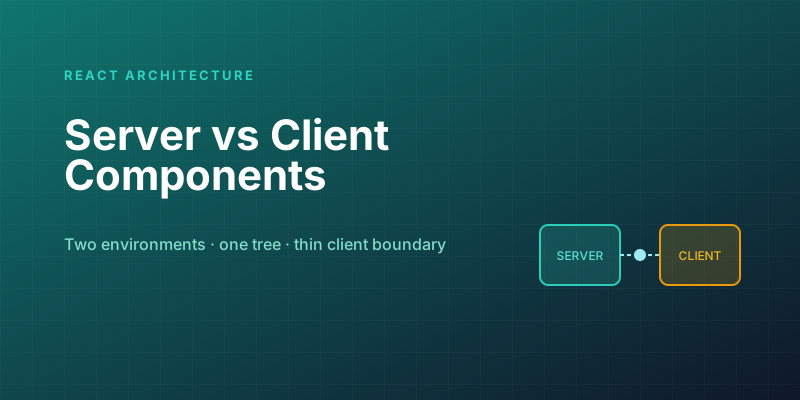
Server Components vs. Client Components: A Mental Model That Sticks
The hardest part of React Server Components isn't the syntax — it's knowing which kind of component you're writing and why. Here is the mental model that makes the boundary obvious.
Optimistic UI Updates: Making Apps Feel Instant Without Lying to Users
The like button that responds before the server confirms feels instant. The trick is updating the UI first and reconciling later — and handling the rollback so you never mislead the user.
Debouncing and Throttling in React: Taming Expensive Event Handlers
A search box that fires a request on every keystroke, a scroll handler running 60 times a second — these are debounce and throttle problems. The concepts are simple; React makes them subtly tricky.

Next.js 16 and React 19: What Actually Matters in 2026
A practical guide to the features that changed how we build React apps — Server Components, the new compiler, and the patterns that stuck.
Building a Real-Time Dashboard with Next.js, Server-Sent Events, and Supabase
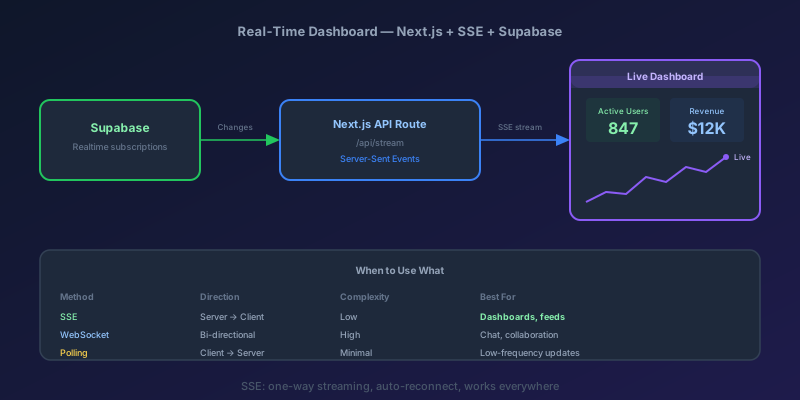
A step-by-step guide to building a live-updating dashboard using Next.js API routes, Server-Sent Events, and Supabase Realtime — with reconnection handling and smooth UI transitions.
Newsletter
New posts, straight to your inbox
One email per post. No spam, no tracking pixels, unsubscribe anytime.
Comments
- No comments yet. Be the first.