Canvas Apps: Concurrent() Is How OnStart Stops Feeling Stuck

OnStart that calls four data sources one after another makes the user stare at a spinner for the sum of four round trips. Those calls usually do not depend on each other. The account list does not need the choice column metadata. The current user's bookings do not need the product catalog. Concurrent() runs them together and finishes when the slowest one finishes, not when all of them have taken turns.
Concurrent(
    ClearCollect(colAccounts, Accounts),
    ClearCollect(colProducts, Products),
    Set(varMe, User())
);
Set(varReady, true);
varReady is the flag the first screen checks. Until it is true, show a skeleton, not a gallery bound to a collection that is still empty. An empty gallery that fills in later looks like "no rows," and people tap New.
What is safe to put in one Concurrent
A call is safe to run beside another when it does not read a variable or collection that the other call writes.
| Safe together | Not safe together |
|---|---|
| Two ClearCollects of different tables | A collect, then a Filter of that same collection |
| User() and a Dataverse list | LookUp of a row whose id comes from the first LookUp |
| Several Set() of unrelated variables | Patch that must see the collection you are still loading |
If you need the user's email before you can filter a list, that filter stays after the Concurrent, or it becomes its own second Concurrent once varMe exists. Nesting dependent work inside one Concurrent does not make it parallel. It makes the order undefined.
Delegation still applies
Concurrent does not raise the delegation limit. A Filter that cannot be delegated still returns a partial set, just sooner. If the gallery was wrong before, it is wrong faster now. Fix the filter — or move the query to a view — before you celebrate the spinner.
The same is true of ForAll inside OnStart. Parallelism does not forgive a loop that Patches a hundred rows on every launch. Load the rows. Patch when the user acts.
Where else it earns its place
OnVisible on a screen that opens a form is the second site. Load the record, the related contacts, and the choice labels together. The form's Item can bind immediately if you already have the record. The related gallery waits on its own collection. Users forgive a related list that fills in. They do not forgive a form that takes three seconds to show the name.
Do not wrap Navigate in Concurrent. Navigation is not a data call, and firing it beside a collect races the screen against the data. Set the collections, then navigate.
Time OnStart before and after on a device, not only in the studio. Studio monitor shows duration per formula. The number that matters is the gap between launch and varReady on a phone on the company network. If one call dominates, Concurrent will not hide it. That call is the one to cache, to narrow with a view, or to stop loading until the screen that needs it.
Keep reading
Patch in Canvas Apps: The Blank Column That Overwrites a Real Value
Patch writes every column present in the change record, including blanks from empty form cards. How to update only the fields the user actually edited.

Dataverse Filtered Record Ownership: Row-Level Security Without Owners, Teams, or Sharing
Dataverse's filtered record ownership (preview) secures rows by column values such as region or department instead of owner or business unit. How record filters, entity record filters, and security roles fit together, and what the no-owner model gives up.

Power Platform September 2026 Update: The App-Builder Skill, Agent Plugins, and the Refreshed Model-Driven UI
What matters in Microsoft's September 2026 Power Platform feature update: the model app-builder skill goes GA, the canvas authoring agent plugin goes GA, generative pages embed in forms and reach connectors, model-driven header refresh is GA with display density in preview, and Power Automate gets server-side search.
SharePoint Lists vs Dataverse for Canvas Apps: Pick the Storage, Not the Habit
Delegation limits, relationships, security, and ALM — the practical tradeoffs when a canvas app outgrows a list and when it should not migrate at all.
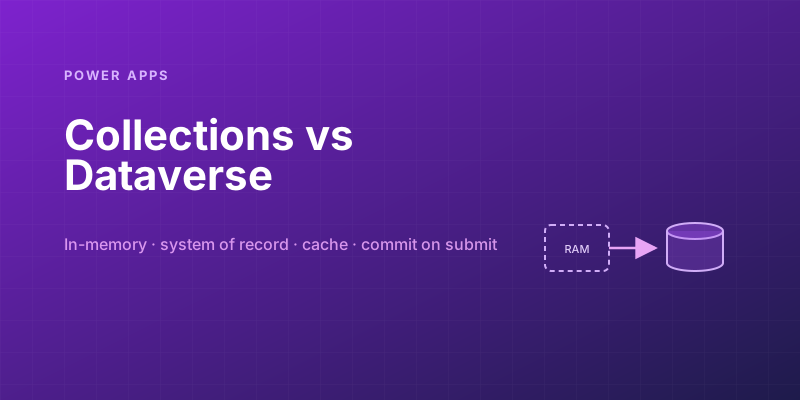
Power Apps Collections vs. Dataverse: Where Your App's Data Should Actually Live
Collections feel fast and convenient, so makers overuse them — and ship apps that lose data and break on refresh. Here is when to hold data in memory and when it belongs in Dataverse.
Canvas vs Model-Driven vs Power Pages: Choosing the Right Power Apps Type
Choose between canvas apps, model-driven apps, and Power Pages using a practical matrix for UX, data, licensing, governance, and audience fit.
Newsletter
New posts, straight to your inbox
One email per post. No spam, no tracking pixels, unsubscribe anytime.
Comments
- No comments yet. Be the first.