Electronic Reporting in Finance 10.0.49: GS1 Barcodes, DIV and MOD, and Copy Counts
Electronic reporting changes in Finance 10.0.49 are easy to skip because they are not a new workspace. Three of them are on by default. Two are Feature management toggles. One model-mapping behavior is mandatory. A handful of older ER switches have been removed from Feature management because the behavior is now permanent. If your formats print labels, paginate, or depend on "Run draft," this build changes the output even when nobody opens Feature management.
The build is 10.0.2790. Self-update is September 2026. Auto-update is October 2026. The wider upgrade triage is in what to regression-test before the October auto-update.
Barcodes: three GS1 formats, already available
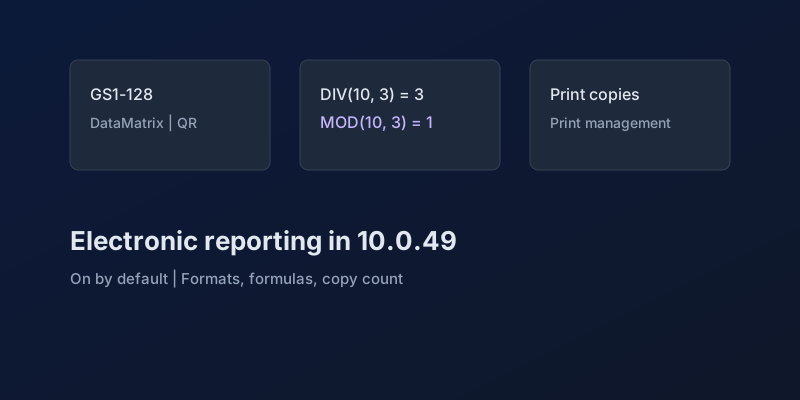
GS1-128, GS1 DataMatrix, and GS1 QR Code are formats on the ER barcode data source. They are on by default. Microsoft's reason is the obvious one: retail, warehouse, transport, and healthcare labels already speak GS1, and ER was generating barcodes without those three formats as first-class options.
Reprint one label that is supposed to be GS1-128 and scan it with the same device the warehouse uses. A barcode that looks right and scans as a different symbology is a failed test. Do this for a format you actually ship. A new demo format that you create during the test only proves the data source exists.
DIV and MOD are integer division, not a new rounding function
DIV(a, b) is integer division. MOD(a, b) is the remainder of that division. Both are in the ER formula language, on by default. Microsoft names the jobs they are for: pagination, packaging quantities, currency splits, period bucketing, and check digits.
A formula that used to imitate integer division with rounding will not automatically switch to DIV. You change the format. When you do, pin two cases in the format designer before you publish:
DIV(10, 3)is 3, andMOD(10, 3)is 1. That is the contract implied by "integer division" and "remainder." Confirm it in your configuration against a known input rather than trusting a mental model of banker's rounding.- A zero or negative divisor. Microsoft's what's-new article does not document that edge. Run it in the designer and keep the result next to the format. Do not ship a check-digit formula that has only been evaluated on happy numbers.
Packaging is the business case worth a real document. If a format prints "cases and units" from a quantity, DIV is the case count and MOD is the leftover units. Compare one item whose quantity divides evenly and one whose quantity does not.
Number of copies is no longer ignored
ER destinations now print the Number of copies set in Print management, and the number requested on an ad-hoc print dialog. This applies to the standard entry points for ER documents driven by Print management. It is on by default.
The regression is a format whose Print management setting says 2 or 3 and whose operators have learned to expect 1, because ER used to ignore the setting. After 10.0.49 those jobs will print the configured count. Walk the print settings for customer invoices, labels, and any check or payment advice that goes through an ER destination. Set the count to what the business actually wants before the October auto-update, or the first print run of the month will be a stack of duplicates.
Toggles, and behaviors that are no longer toggles
Two enhancements stay off until Feature management says otherwise:
- Optimize memory consumption for large ER executions. Microsoft describes less peak memory from fewer temporary objects, less duplicated data, and more reuse of structures that already exist. Turn it on for one heavy format — a statutory report you already know spikes the batch server — and compare runtime and peak memory to the last successful run. Leave it off for every other format until that one is clean.
- Enhanced validation management for ER configurations. Several configuration versions can be validated in one operation, with validation tracked per version and a history that persists. Use it when you are promoting a set of French, tax, or label formats together. It does not change runtime output.
Always take into consideration the 'Run draft' option for ER model mappings is mandatory in 10.0.49. A draft mapping that used to be skipped will be respected when Run draft is set. If a sandbox has unfinished draft mappings, a test run can pick them up. Finish them or stop using Run draft before you treat a sandbox result as evidence about production.
These ER features were removed from Feature management. The behavior stays, and the off switch does not:
| Feature name, as listed | Microsoft's note |
|---|---|
| Cache the preferred language of the current user for ER runs | Enabled by default |
| Enable support of Document Routing Agent running as a service | Enabled by default |
| Forcing to use for data parsing only cell data types that are defined in an ER format | Enabled by default |
| Apply the 'Language preference' parameter to the 'File name' expression | Enabled by default |
| Enhanced access to labels of the ascendent ER data model | Enabled by default |
| Validate obsolete elements of Electronic Reporting data sources | Enabled by default |
The parsing rule is the one that changes a file import. A format that used to accept a cell whose type did not match the format can now fail validation, because that stricter parsing is no longer optional. Re-import one known-good file and one file that only worked because the parser was lenient.
Reprint a label, print a multi-copy invoice, and re-import one file. That is the ER test for this build. Formula rewrites to DIV and MOD are a format project, scheduled when someone is changing that format anyway.
Keep reading

crossCompany in X++: The Query That Mixes Legal Entities
A normal select stays in the current company. crossCompany returns every legal entity the user may read. How the company container, changeCompany, and OData differ.
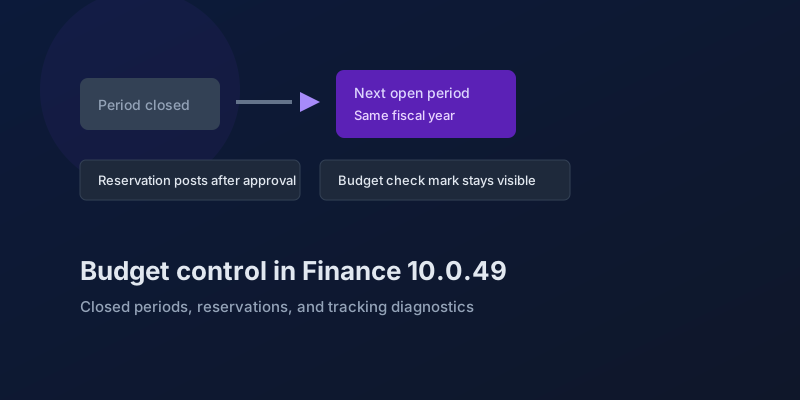
Budget Control in Finance 10.0.49: Closed Periods, Reservations, and Broken Tracking
The budgeting features in Dynamics 365 Finance 10.0.49 — accounting-date advancement, reservation posting, encumbrance reporting, and a diagnostic for corrupt budget tracking.
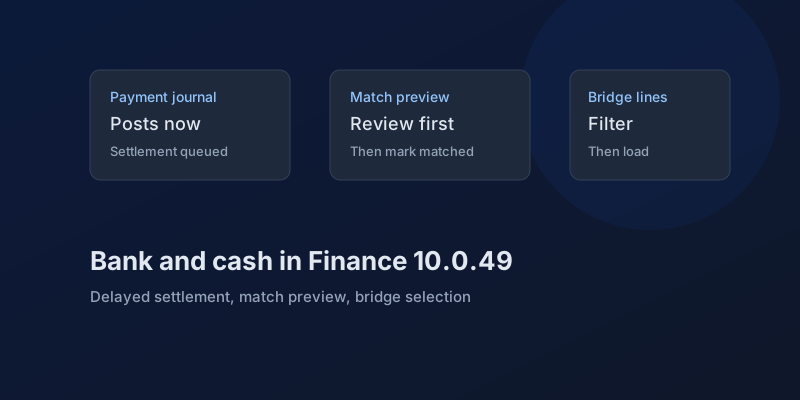
Bank and Cash in Finance 10.0.49: Delayed Settlement, Match Preview, and Bridge Selection
What Dynamics 365 Finance 10.0.49 changes in payment journals and bank reconciliation, which pieces are still preview, and which bank behaviors you can no longer disable.
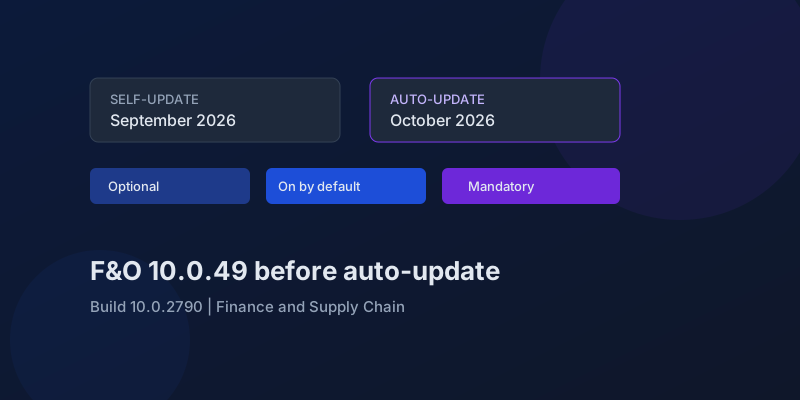
D365 F&O 10.0.49: What to Regression-Test Before the October Auto-Update
Finance and Supply Chain 10.0.49 (build 10.0.2790) is self-update in September 2026 and auto-update in October. Here is the feature-state triage that actually matters.

Agentic ERP in September 2026: What Is Available, in Preview, and Still a Date
A precise reading of Microsoft's 23 September 2026 Dynamics 365 ERP announcement, the 10.0.49 previews behind it, and the financial-journal dates that are not this fall.
France E-Invoicing and E-Reporting in D365 Finance: What 10.0.49 Actually Files
How Dynamics 365 Finance splits French domestic B2B e-invoicing from e-reporting, which build carries it, and what SIREN, SIRET, and establishment setup must be true before you transmit.
Newsletter
New posts, straight to your inbox
One email per post. No spam, no tracking pixels, unsubscribe anytime.
Comments
- No comments yet. Be the first.