France E-Invoicing and E-Reporting in D365 Finance: What 10.0.49 Actually Files
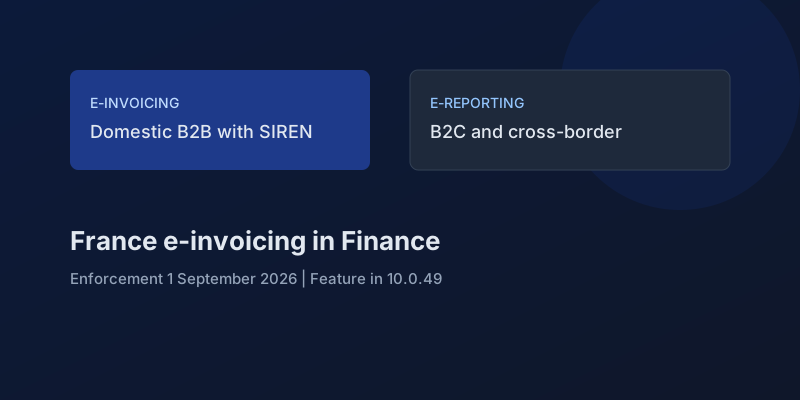
French e-invoicing enforcement, as Microsoft's 2026 release wave 1 plan states it, started on 1 September 2026. Dynamics 365 Finance's support for that reform is generally available. The e-reporting half of it — transmission des données de transaction — is documented as available from Finance 10.0.49, and also on specific earlier builds: 10.0.48 build 10.0.2645.55 and 10.0.47 build 10.0.2527.135. If a sandbox is still on an older build of 10.0.47 or 10.0.48, "we are on the wave" is not the same as "this feature is in the binary."
The mistake that produces a wrong filing is treating every French invoice as an e-invoice. Microsoft's own scope rule is the opposite. E-invoicing and e-reporting cover different transactions, and a customer with no SIREN is the switch.
E-invoicing is domestic B2B with a SIREN
The wave 1 feature, generally available on 24 July 2026, covers electronic invoicing inside Dynamics 365 Finance for companies that operate in France:
- Domestic B2B invoices and credit notes from sales orders, free-text invoices, and project invoices.
- A UBL-based payload sent to the business partner and to the French tax authorities through EDICOM, acting as an accredited platform (Plateforme Agréée, formerly PDP).
- Vendor electronic invoices received through that same provider.
- The invoice lifecycle statuses French legislation requires.
Learn's electronic invoicing article draws the boundary in one sentence. Individual e-invoice submission includes invoices issued to customers that have a nonempty SIREN for country/region FRA. Every other invoice is excluded from e-invoicing and considered for e-reporting.
That is the test, before any format argument. Post one domestic invoice to a French customer with a SIREN and confirm it is a candidate for e-invoicing. Post one invoice to a French consumer, or to a customer whose FRA SIREN is blank, and confirm it is not submitted as an e-invoice.
E-reporting is everything VAT-relevant that e-invoicing does not take
France e-reporting collects transaction data from Finance documents and transforms it with Electronic reporting. Microsoft limits it to transactions outside mandatory e-invoicing:
- B2C transactions.
- Cross-border B2B and B2C transactions.
- Payment data for transactions where VAT is due upon payment.
Transmission is per reporting period, and the period depends on the declarant's VAT regime. Select that regime when report generation is configured.
| VAT regime | How Microsoft describes the period |
|---|---|
| Standard | Monthly regime. Transaction data in ten-day periods. Payment data monthly. |
| Simplified | Quarterly regime. Monthly periods. |
| Franchise in base | Bimonthly periods, two civil months. |
Each transmission covers a single period. A period already submitted is corrected with a rectifying transmission, not by editing the original send. A close calendar that assumes one monthly file for every French company will be wrong for two of these three regimes.
10.0.49 lists Electronic reporting of transactions for France (e-Reporting) under Feature management. Generally available does not mean the toggle is gone. Enable it in the legal entity that files, after registration IDs exist.
Registration IDs and establishments are the prerequisite, not the format
Microsoft's e-reporting article says not to configure the report until three things are true:
- Registration IDs exist: VAT ID, SIREN, and SIRET, for country/region FRA.
- The establishment structure is configured.
- Transactions are associated with the correct establishment.
SIREN identifies the legal entity and is unique. SIRET identifies the establishment and is not unique, so a head office and its head-office establishment can share an identifier. VAT ID maps to the VAT ID registration category. SIREN maps to Enterprise ID (COID). SIRET maps to the SIRET category. Invoice party applicability rules decide which party roles must carry which ID at posting, and which address purposes are evaluated.
A useful failure is an invoice that will not post because the French customer has no SIREN and the applicability rule requires one. That failure is cheaper than a file EDICOM accepts and the authority rejects. An invoice that posts with the legal entity's SIREN and the wrong establishment's SIRET is the quieter defect. Spot-check the establishment on the posted invoice, not only the customer record.
What to run before the next transmission
- Confirm the application build, not only the 10.0.x version, if you are not yet on 10.0.49.
- Import the French globalization features and confirm the ER configurations they pull in, including the sales, project, and vendor invoice formats and the lifecycle-status formats. The feature import is what brings those configurations. Review them in the Electronic reporting workspace rather than assuming the repository copy matches the last environment refresh.
- File one domestic B2B invoice, one domestic credit note, one project invoice, and one vendor invoice received through the provider. Lifecycle status has to come back, not only the outbound send.
- File one B2C or cross-border transaction through e-reporting, for a single period that matches the VAT regime on the report setup.
- Submit a rectifying transmission for that same period and confirm the platform treats it as a correction.
Companies outside France can ignore this. Companies with one French legal entity cannot treat it as a localization checkbox on the 10.0.49 upgrade. The upgrade note is in what to regression-test before the October auto-update. The filing test is this one.
Keep reading
crossCompany in X++: The Query That Mixes Legal Entities
A normal select stays in the current company. crossCompany returns every legal entity the user may read. How the company container, changeCompany, and OData differ.
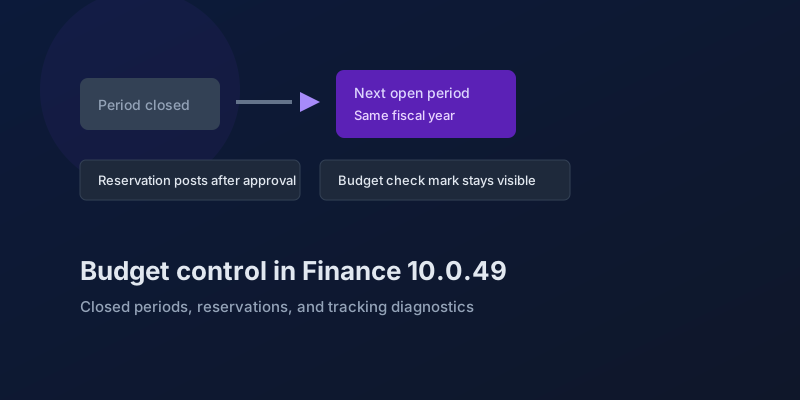
Budget Control in Finance 10.0.49: Closed Periods, Reservations, and Broken Tracking
The budgeting features in Dynamics 365 Finance 10.0.49 — accounting-date advancement, reservation posting, encumbrance reporting, and a diagnostic for corrupt budget tracking.
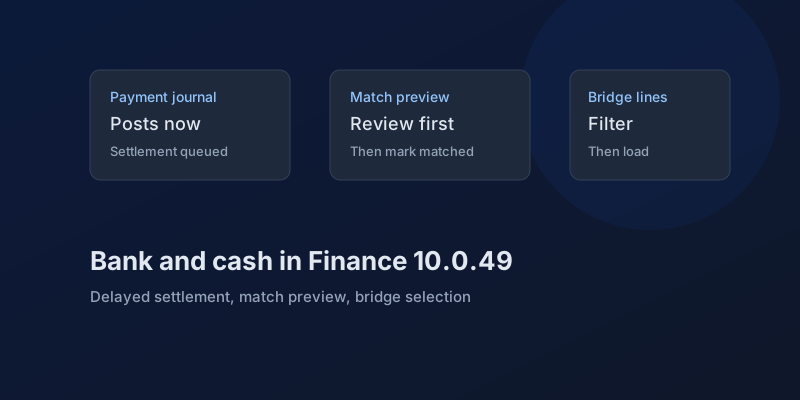
Bank and Cash in Finance 10.0.49: Delayed Settlement, Match Preview, and Bridge Selection
What Dynamics 365 Finance 10.0.49 changes in payment journals and bank reconciliation, which pieces are still preview, and which bank behaviors you can no longer disable.
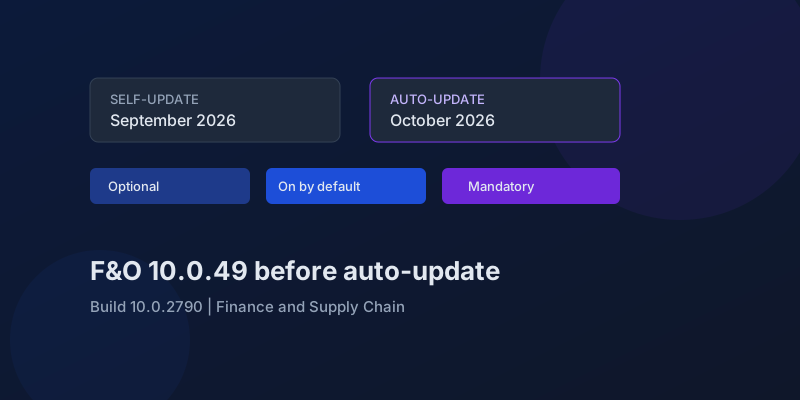
D365 F&O 10.0.49: What to Regression-Test Before the October Auto-Update
Finance and Supply Chain 10.0.49 (build 10.0.2790) is self-update in September 2026 and auto-update in October. Here is the feature-state triage that actually matters.
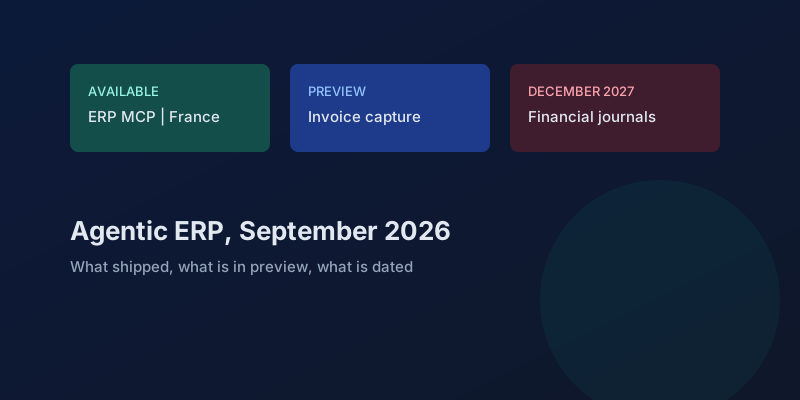
Agentic ERP in September 2026: What Is Available, in Preview, and Still a Date
A precise reading of Microsoft's 23 September 2026 Dynamics 365 ERP announcement, the 10.0.49 previews behind it, and the financial-journal dates that are not this fall.
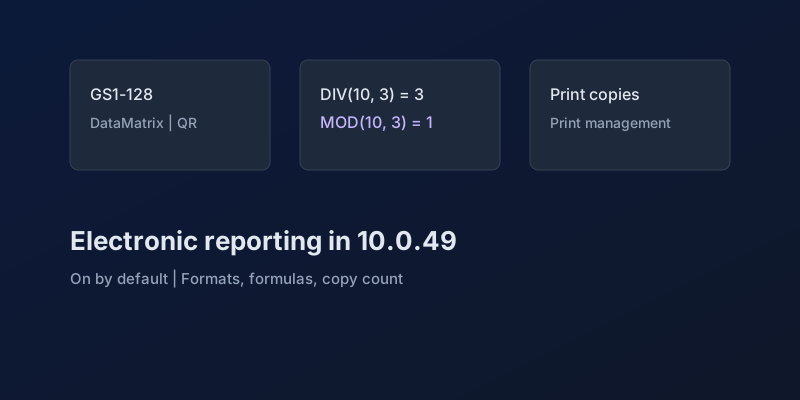
Electronic Reporting in Finance 10.0.49: GS1 Barcodes, DIV and MOD, and Copy Counts
What Dynamics 365 Finance 10.0.49 changes in Electronic Reporting without a feature debate — barcode formats, integer formulas, print copies — and which ER behaviors are now mandatory.
Newsletter
New posts, straight to your inbox
One email per post. No spam, no tracking pixels, unsubscribe anytime.
Comments
- No comments yet. Be the first.