D365 F&O 10.0.49: What to Regression-Test Before the October Auto-Update
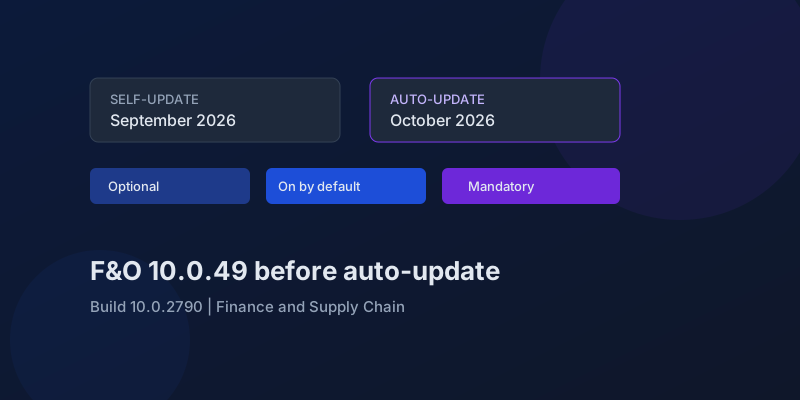
Dynamics 365 Finance and Dynamics 365 Supply Chain Management version 10.0.49, build 10.0.2790, follows the schedule Microsoft published on Learn: preview in July 2026, general availability for self-update in September 2026, and general availability for auto-update in October 2026. The build number is the same on both apps because they share the platform update.
The useful work before that October window is a feature-state review, not a reread of every row in the what's-new articles. Most of the pain in this release is behavior you can no longer turn off, plus two deprecations that will not show up as a red compile error.
Microsoft also flags the Finance 10.0.49 article itself: some or all of the functionality described there is preview and can change. Treat anything that is not in the "on by default," "mandatory," or "removed from Feature management" tables as optional until you confirm its state in your own workspace.
Sort the workspace into four piles
Feature management in this release still uses the same lifecycle described in Feature Management in D365 Finance and Operations. For 10.0.49, put every new or changed feature into one of these piles before you touch a test script.
| Pile | What Microsoft did | What you do before production |
|---|---|---|
| New, admin or Feature management | Shipped in the build, off until someone enables it | Enable in a sandbox only, with a named owner |
| On by default | Enabled, and you can still disable it | Regression-test now. The off switch is temporary |
| Mandatory | Still listed, toggle gone | Test the behavior. You cannot opt out |
| Removed from Feature management | No longer listed. The behavior is permanent | Update runbooks that still say "turn this off" |
A database refresh from production will wipe sandbox feature state. Enable the sandbox set after the refresh, or the test pass documents the wrong configuration.
Finance: the mandatory list is the upgrade
The new Finance capabilities — line-level customer prepayments, the budgeting additions, delayed settlement, bank-match preview, and the fixed-asset reporting-currency work — are covered in the companion notes on bank reconciliation and budget control. They are not the default risk. The default risk is the set Microsoft made mandatory.
In Finance 10.0.49 that set clusters in three places:
- Accounts receivable and payable. Customer and vendor netting, missed maturity dates on postdated checks, empty payment journals from the proposal, card payment processing, cash-flow sales-tax authority payments, and several country-specific settlement and split-payment behaviors (Italy, Norway, Poland, Brazil, Eastern Europe).
- Cash and bank management. Check-number validation, maturity-date checks when posting postdated checks to a bank account, cash position and cash control, marking bank transactions cleared, prepayment and posting profile on journals generated from advanced bank reconciliation, reversal handling, latest exchange rate on bank transactions, batch posting of statements, cleared-date updates, and automatic clearing of bridged transactions. "(Brazil) Mandatory bank transaction description" is mandatory as well.
- Tax and general ledger. Batch synchronization of tax-hierarchy versions, India's option to include TCS in total invoice value, a new calculation choice for the VAT register filling date, reverse-charge inheritance of an empty tax base across vendor-invoice journal lines, and the exchange-rate type enhancement for AP and AR foreign-currency revaluation.
Two explicitly labeled preview features should stay out of a production enablement plan until Microsoft removes that label: fixed assets reporting currency adjustment, and the subscription-billing correction for multi-element revenue allocation on update and termination.
Electronic reporting also changes without a Feature management debate. GS1-128, GS1 DataMatrix, and GS1 QR Code are available in the barcode data source. DIV and MOD are in the formula language. Print management's Number of copies is honored by ER destinations. Those three are on by default. Memory optimization for large ER runs, and validation of multiple configuration versions in one operation, are Feature management toggles.
France e-reporting (transmission of transaction data under the e-invoicing reform) is included in this build behind Feature management. Microsoft's 23 September 2026 product blog describes France e-invoicing and e-reporting support as generally available. If you file in France, this is a configuration and intermediary-platform test, not a "new module" surprise.
Supply chain: quality, inventory visibility, and a few sharp defaults
Supply Chain Management 10.0.49 adds optional work you should schedule, and mandatory work you should assume is already on after the update.
Turn these on deliberately. They are preview or Feature management:
- (Preview) Supplier Engagement, the supplier workspace and portal across legal entities. The 23 September announcement describes the same capability as public preview, covering onboarding, requests for quotation, purchase orders, and invoicing.
- (Preview) Optimized inventory transaction consolidation.
- (Preview) Use same batch selection for raw materials in production, which enforces same-batch selection on production and batch orders.
- Planning Optimization toggles for the transport calendar's closed-for-pickup policy, sub-BOM and sub-route in supply-forecast reduction, and filtering derived requirements by the coverage time fence.
- Enable financial tags for purchase order invoicing.
Already on, and worth a warehouse regression because you can still turn them off:
- Import inbound ASNs as despatch advice messages.
- Prevent multiple owners in a warehouse location.
- Source-system inventory status mapping.
- RFQ bid–driven fixed asset field updates (on by default, not merely available).
- (Production ready preview) Dynamic work classification, which moved from preview to on by default in this version.
Mandatory, so the off switch is gone:
- Advanced quality management and dispense management.
- The Inventory Visibility integrations for ATP, reservation offset, transaction sync, and warehouse items.
- Aggregated material availability on work orders, and the credit-limit check on work order dispatch.
- Recalculate delivery dates when a direct delivery is created.
- Lookup-based search on the sales external item identifier, which went from preview straight to mandatory.
- Vendor-rebate consolidation for the same vendor, and posting rebate outputs to the purchase-order vendor.
One production-control enhancement is easy to miss because it is an error, not a new form. After time registrations for the day are calculated, workers cannot clock in, clock out, or start and stop jobs. The message tells them to contact a supervisor. The supervisor clears it from the Approve page with Undo calculation for today. If your shop floor calculates registrations before the shift is actually finished, this will stop the line until someone knows that button.
Two deprecations that belong on the upgrade ticket
Microsoft's removed-or-deprecated list for the 10.0.49 release names two items that are not Feature management trivia.
Global Inventory Accounting is deprecated, with end of support on 1 July 2027. It affects Finance and Supply Chain Management, cloud and on-premises. The stated successor is a multi-ledger costing solution. If production uses GIA, the September update does not remove it, and it does start the clock. Inventory the legal entities that post through it and plan the transition in a test environment before that date. If GIA exists only in a sandbox, disable it and stop new designs that depend on it.
Follow-up questions in the Copilot sidecar are removed. The preview never reached general availability, and Microsoft says it is gone from finance and operations apps. Anything in a test script or a demo that asked a second question in that sidecar will fail. That is a removed preview, not a replaced feature.
A sandbox sequence that fits the window
- Apply 10.0.49 to a sandbox that was refreshed from production after the last close, then re-apply the feature set you intend to test.
- Run the processes behind the mandatory clusters: settlement and netting, advanced bank reconciliation, tax calculation on a vendor invoice journal, quality orders, Inventory Visibility sync, and a direct delivery.
- Enable the new budgeting and bank features in that sandbox only, using the checks in the companion posts.
- Leave the two labeled Finance previews, Supplier Engagement, same-batch selection, and optimized inventory consolidation disabled in production until each has an owner and a passed script.
- Take the self-update in September on your calendar, or accept the October auto-update. The feature behavior does not wait for a separate project.
Bug-level detail for the build lives in the Lifecycle Services KB for 10.0.49. The Learn articles are the feature contract. When they disagree with a partner recap or a memory of an older wave, use Learn, then confirm the toggle in the workspace. Feature names in this release are occasionally a word apart ("form" versus "page" on the budget register entries performance enhancement). Search the workspace for the noun, not the whole sentence.
Keep reading
crossCompany in X++: The Query That Mixes Legal Entities
A normal select stays in the current company. crossCompany returns every legal entity the user may read. How the company container, changeCompany, and OData differ.
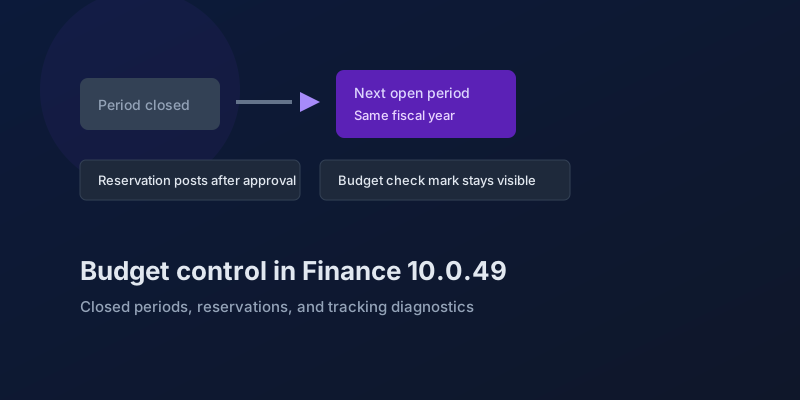
Budget Control in Finance 10.0.49: Closed Periods, Reservations, and Broken Tracking
The budgeting features in Dynamics 365 Finance 10.0.49 — accounting-date advancement, reservation posting, encumbrance reporting, and a diagnostic for corrupt budget tracking.
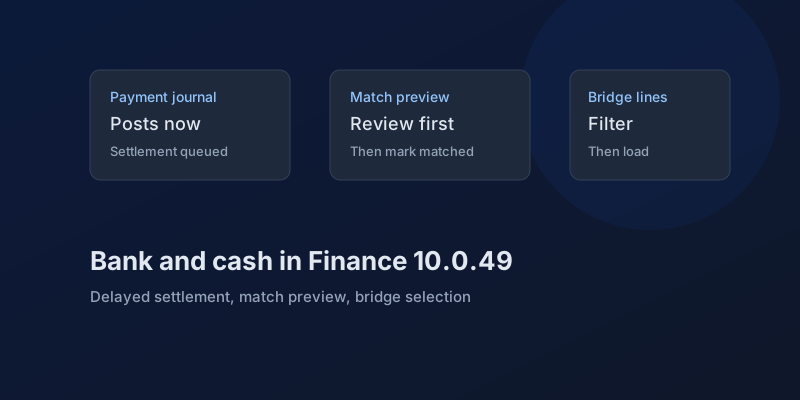
Bank and Cash in Finance 10.0.49: Delayed Settlement, Match Preview, and Bridge Selection
What Dynamics 365 Finance 10.0.49 changes in payment journals and bank reconciliation, which pieces are still preview, and which bank behaviors you can no longer disable.
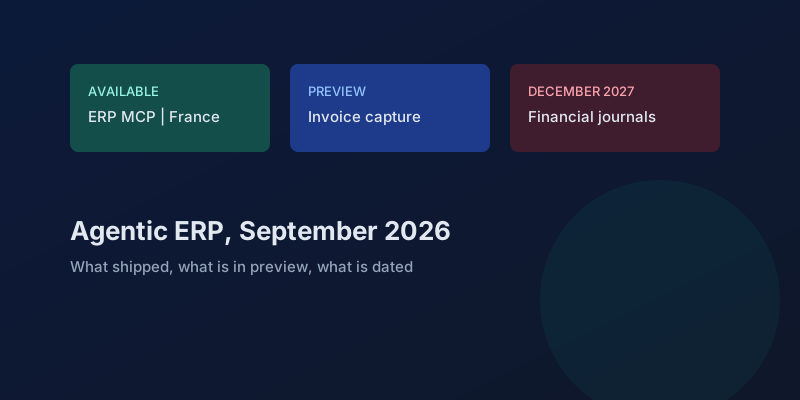
Agentic ERP in September 2026: What Is Available, in Preview, and Still a Date
A precise reading of Microsoft's 23 September 2026 Dynamics 365 ERP announcement, the 10.0.49 previews behind it, and the financial-journal dates that are not this fall.
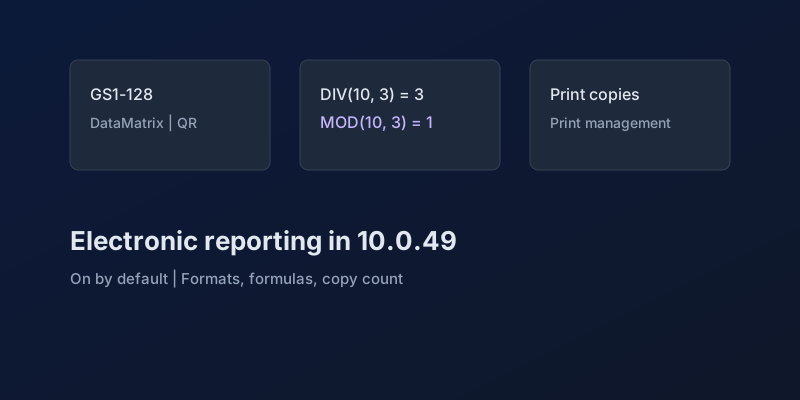
Electronic Reporting in Finance 10.0.49: GS1 Barcodes, DIV and MOD, and Copy Counts
What Dynamics 365 Finance 10.0.49 changes in Electronic Reporting without a feature debate — barcode formats, integer formulas, print copies — and which ER behaviors are now mandatory.
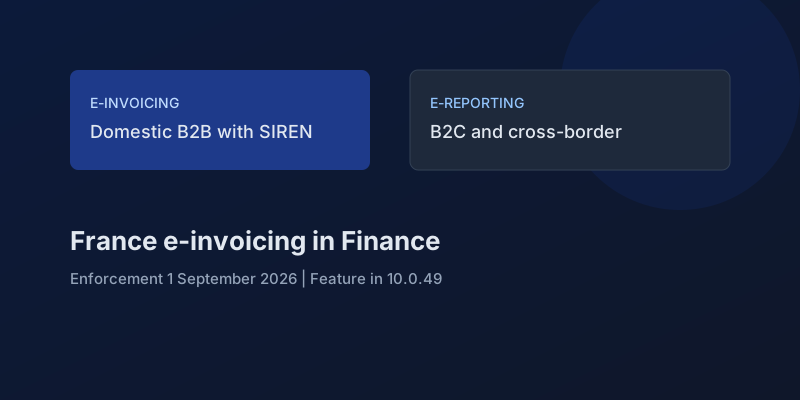
France E-Invoicing and E-Reporting in D365 Finance: What 10.0.49 Actually Files
How Dynamics 365 Finance splits French domestic B2B e-invoicing from e-reporting, which build carries it, and what SIREN, SIRET, and establishment setup must be true before you transmit.
Newsletter
New posts, straight to your inbox
One email per post. No spam, no tracking pixels, unsubscribe anytime.
Comments
- No comments yet. Be the first.